
Skip to content
NGTEdu Logo

NGTEdu

A PRODUCT OF NGTECH.CO.IN

NGTEdu Logo

NGTEdu

  • Home
  • Cyber Attacks
  • Malware
  • Vulnerabilities
  • Data Breach
  • Home
  • Data Breach
  • Google Chrome wants to fix your unsafe passwords
  • Data Breach

Google Chrome wants to fix your unsafe passwords

5 years ago Graham Cluley
Google Chrome wants to fix your unsafe passwords

Most security breaches are the result of one thing: sloppy password practices. Too many people make the mistake of choosing weak passwords, or reusing passwords that they have used elsewhere on the internet – making life too easy for malicious hackers trying to gain unauthorised access.

So I was pleased to see Google announce that over the coming weeks it will be rolling out a new feature to users of its Chrome browser which will make it easier to check for weak passwords and warn if stored passwords have been compromised in a past data breach.

Chrome users who store their passwords in the browser’s built-in password manager will be able to check if their passwords are weak or have been compromised by going to Settings > Passwords > Check passwords > Check Now, or automatically after logging into websites.
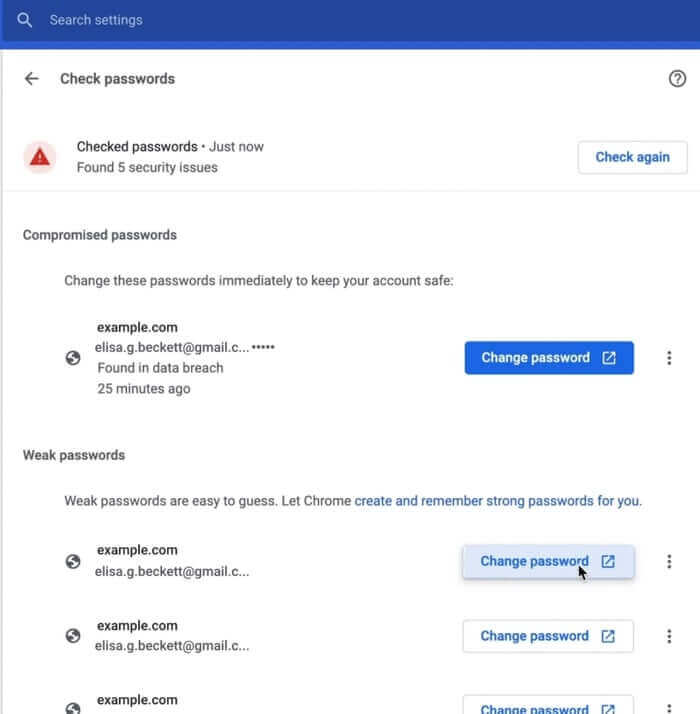
And, of course, once a weak or compromised password has been spotted it can be replaced to a stronger, safer password on the spot.

These password security audits come as part of the browser’s “Safety Check” feature introduced last year.

Google Safety Check

Google says that Chrome’s Safety Check feature is used 14 million time every week, and since its introduction there has been a 38% reduction in the number of compromised login passwords stored in the browser.

With the latest enhancements, according to Google, users will be able to “update multiple usernames easily, in one convenient place.” Initially the improved feature set will be available on the desktop and iOS versions of Chrome, but will be coming to the Android version “soon.”

Personally, I’m more of a fan of using a third-party password manager than the one built into my web browser – but any kind of password manager is better than none at all, and anything that helps computer users raise their game when it comes to the passwords they use online has to be good news.


Editor’s Note: The opinions expressed in this guest author article are solely those of the contributor, and do not necessarily reflect those of Tripwire, Inc.

The post ” Google Chrome wants to fix your unsafe passwords” appeared first on TripWire

Source:TripWire – Graham Cluley

Tags: Android, Encryption, Google, Google Chrome, Privacy, TripWire

Continue Reading

Previous Here’s How SolarWinds Hackers Stayed Undetected for Long Enough
Next Cyberattackers breaking in through COVID-19 vaccination data Cyberattackers breaking in through COVID-19 vaccination data

More Stories

  • Critical Vulnerability
  • Cyber Attacks
  • Data Breach
  • Vulnerabilities

Critical n8n Flaw CVE-2026-25049 Enables System Command Execution via Malicious Workflows

1 hour ago [email protected] (The Hacker News)
  • Critical Vulnerability
  • Cyber Attacks
  • Data Breach
  • Vulnerabilities

Malicious NGINX Configurations Enable Large-Scale Web Traffic Hijacking Campaign

3 hours ago [email protected] (The Hacker News)
  • Cyber Attacks
  • Data Breach

Microsoft Develops Scanner to Detect Backdoors in Open-Weight Large Language Models

14 hours ago [email protected] (The Hacker News)
  • Cyber Attacks
  • Data Breach
  • Malware
  • Vulnerabilities

DEAD#VAX Malware Campaign Deploys AsyncRAT via IPFS-Hosted VHD Phishing Files

14 hours ago [email protected] (The Hacker News)
  • Cyber Attacks
  • Data Breach
  • Malware
  • Vulnerabilities

China-Linked Amaranth-Dragon Exploits WinRAR Flaw in Espionage Campaigns

17 hours ago [email protected] (The Hacker News)
  • Data Breach

Orchid Security Introduces Continuous Identity Observability for Enterprise Applications

19 hours ago [email protected] (The Hacker News)

Recent Posts

  • Critical n8n Flaw CVE-2026-25049 Enables System Command Execution via Malicious Workflows
  • Malicious NGINX Configurations Enable Large-Scale Web Traffic Hijacking Campaign
  • Microsoft Develops Scanner to Detect Backdoors in Open-Weight Large Language Models
  • DEAD#VAX Malware Campaign Deploys AsyncRAT via IPFS-Hosted VHD Phishing Files
  • China-Linked Amaranth-Dragon Exploits WinRAR Flaw in Espionage Campaigns

Tags

Android APT Bug CERT Cloud Compliance Coronavirus COVID-19 Critical Severity Encryption Exploit Facebook Finance Google Google Chrome Goverment Hacker Hacker News High Severity Instagram iPhone Java Linux Low Severity Malware Medium Severity Microsoft Moderate Severity Mozzila Firefox Oracle Patch Tuesday Phishing Privacy QuickHeal Ransomware RAT Sim The Hacker News Threatpost TikTok TripWire VMWARE Vulnerability Whatsapp Zoom
Copyright © 2020 All rights reserved | NGTEdu.com
This website uses cookies to improve your experience. We'll assume you're ok with this, but you can opt-out if you wish. Read More here.Cookie settingsACCEPT
Privacy & Cookies Policy

Privacy Overview

This website uses cookies to improve your experience while you navigate through the website. Out of these cookies, the cookies that are categorized as necessary are stored on your browser as they are essential for the working of basic functionalities of the website. We also use third-party cookies that help us analyze and understand how you use this website. These cookies will be stored in your browser only with your consent. You also have the option to opt-out of these cookies. But opting out of some of these cookies may have an effect on your browsing experience.
Necessary
Always Enabled
Necessary cookies are absolutely essential for the website to function properly. This category only includes cookies that ensures basic functionalities and security features of the website. These cookies do not store any personal information.
Non-necessary
Any cookies that may not be particularly necessary for the website to function and is used specifically to collect user personal data via analytics, ads, other embedded contents are termed as non-necessary cookies. It is mandatory to procure user consent prior to running these cookies on your website.
SAVE & ACCEPT