
Skip to content
NGTEdu Logo

NGTEdu

A PRODUCT OF NGTECH.CO.IN

NGTEdu Logo

NGTEdu

  • Home
  • Cyber Attacks
  • Malware
  • Vulnerabilities
  • Data Breach
  • Home
  • Cyber Attacks
  • 10,000 organisations targeted by phishing attack that bypasses multi-factor authentication
  • Cyber Attacks
  • Data Breach
  • Vulnerabilities

10,000 organisations targeted by phishing attack that bypasses multi-factor authentication

4 years ago Graham Cluley
10,000 organisations targeted by phishing attack that bypasses multi-factor authentication

Microsoft has shared details of a widespread phishing campaign that not only attempted to steal the passwords of targeted organisations, but was also capable of circumventing multi-factor authentication (MFA) defences.

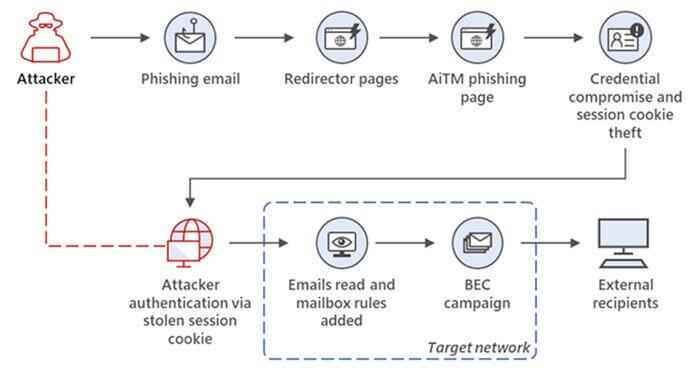
The attackers used AiTM (Attacker-in-The-Middle) reverse-proxy sites to pose as Office 365 login pages which requested MFA codes, and then use them to log into the genuine site.

According to Microsoft’s detailed report on the campaign, once hackers had broken into email inboxes via the use of stolen passwords and session cookies, they would exploit their access to launch Business Email Compromise (BEC) attacks on other targets.

By creating rules on victims’ email accounts, the attackers are able to then ensure that they are able to maintain access to incoming email even if a victim later changes their password.
The global pandemic, and the resulting increase in staff working from home, has helped fuel a rise in the adoption of multi-factor authentication.

Cybercriminals, however, haven’t thrown in the towel when faced with MFA-protected accounts. Accounts with MFA are certainly less trivial to break into than accounts which haven’t hardened their security, but that doesn’t mean that it’s impossible.

Reverse-proxy phishing kits like Modlishka, for instance, impersonate a login page, and ask unsuspecting users to enter their login credentials and MFA code. That collected data is then passed to the genuine website – granting the cybercriminal access to the site.

As more and more people recognise the benefits of MFA, we can expect a rise in the number of cybercriminals investing effort into bypassing MFA.

Microsoft’s advice is that organisations should complement MFA with additional technology and best practices.

These include enabling conditional access policies (for instance, testing that logins are coming from trusted IP addresses and compliant devices), the deployment of anti-phishing defences at the email and web gateways, detection of unusual mailbox activity (such as the creation of suspicious inbox rules, and logins with unusual characteristics.)

More technical information about the attacks can be found in Microsoft’s report.

“While AiTM phishing attempts to circumvent MFA, it’s important to underscore that MFA implementation remains an essential pillar in identity security,” said Microsoft. “MFA is still very effective at stopping a wide variety of threats; its effectiveness is why AiTM phishing emerged in the first place.”

Hear hear.


Editor’s Note: The opinions expressed in this guest author article are solely those of the contributor, and do not necessarily reflect those of Tripwire, Inc.

The post ” 10,000 organisations targeted by phishing attack that bypasses multi-factor authentication” appeared first on TripWire

Source:TripWire – Graham Cluley

Tags: Encryption, Exploit, Microsoft, Phishing, TripWire

Continue Reading

Previous State-Backed Hackers Targeting Journalists in Widespread Espionage Campaigns
Next Former CIA Engineer Convicted of Leaking ‘Vault 7’ Hacking Secrets to Wikileaks

More Stories

  • Cyber Attacks
  • Data Breach
  • Vulnerabilities

OpenClaw Bug Enables One-Click Remote Code Execution via Malicious Link

3 hours ago [email protected] (The Hacker News)
  • Cyber Attacks
  • Data Breach

Microsoft Begins NTLM Phase-Out With Three-Stage Plan to Move Windows to Kerberos

4 hours ago [email protected] (The Hacker News)
  • Critical Vulnerability
  • Cyber Attacks
  • Data Breach
  • Malware
  • Vulnerabilities

⚡ Weekly Recap: Proxy Botnet, Office Zero-Day, MongoDB Ransoms, AI Hijacks & New Threats

8 hours ago [email protected] (The Hacker News)
  • Critical Vulnerability
  • Cyber Attacks
  • Data Breach

Securing the Mid-Market Across the Complete Threat Lifecycle

8 hours ago [email protected] (The Hacker News)
  • Cyber Attacks
  • Data Breach
  • Malware
  • Vulnerabilities

Notepad++ Official Update Mechanism Hijacked to Deliver Malware to Select Users

11 hours ago [email protected] (The Hacker News)
  • Critical Vulnerability
  • Cyber Attacks
  • Data Breach
  • Malware
  • Vulnerabilities

eScan Antivirus Update Servers Compromised to Deliver Multi-Stage Malware

14 hours ago [email protected] (The Hacker News)

Recent Posts

  • OpenClaw Bug Enables One-Click Remote Code Execution via Malicious Link
  • Microsoft Begins NTLM Phase-Out With Three-Stage Plan to Move Windows to Kerberos
  • ⚡ Weekly Recap: Proxy Botnet, Office Zero-Day, MongoDB Ransoms, AI Hijacks & New Threats
  • Securing the Mid-Market Across the Complete Threat Lifecycle
  • Notepad++ Official Update Mechanism Hijacked to Deliver Malware to Select Users

Tags

Android APT Bug CERT Cloud Compliance Coronavirus COVID-19 Critical Severity Encryption Exploit Facebook Finance Google Google Chrome Goverment Hacker Hacker News High Severity Instagram iPhone Java Linux Low Severity Malware Medium Severity Microsoft Moderate Severity Mozzila Firefox Oracle Patch Tuesday Phishing Privacy QuickHeal Ransomware RAT Sim The Hacker News Threatpost TikTok TripWire VMWARE Vulnerability Whatsapp Zoom
Copyright © 2020 All rights reserved | NGTEdu.com
This website uses cookies to improve your experience. We'll assume you're ok with this, but you can opt-out if you wish. Read More here.Cookie settingsACCEPT
Privacy & Cookies Policy

Privacy Overview

This website uses cookies to improve your experience while you navigate through the website. Out of these cookies, the cookies that are categorized as necessary are stored on your browser as they are essential for the working of basic functionalities of the website. We also use third-party cookies that help us analyze and understand how you use this website. These cookies will be stored in your browser only with your consent. You also have the option to opt-out of these cookies. But opting out of some of these cookies may have an effect on your browsing experience.
Necessary
Always Enabled
Necessary cookies are absolutely essential for the website to function properly. This category only includes cookies that ensures basic functionalities and security features of the website. These cookies do not store any personal information.
Non-necessary
Any cookies that may not be particularly necessary for the website to function and is used specifically to collect user personal data via analytics, ads, other embedded contents are termed as non-necessary cookies. It is mandatory to procure user consent prior to running these cookies on your website.
SAVE & ACCEPT