
Skip to content
NGTEdu Logo

NGTEdu

A PRODUCT OF NGTECH.CO.IN

NGTEdu Logo

NGTEdu

  • Home
  • Cyber Attacks
  • Malware
  • Vulnerabilities
  • Data Breach
  • Home
  • Cyber Attacks
  • Wall Street targeted by new Capital Call investment email scammers
  • Cyber Attacks
  • Data Breach

Wall Street targeted by new Capital Call investment email scammers

5 years ago Graham Cluley
Wall Street targeted by new Capital Call investment email scammers

Business Email Compromise (BEC) scammers, who have made rich returns in recent years tricking organisations into transferring funds into their accounts, have found a new tactic which attempts to swindle Wall Street firms out of significantly larger amounts of money.

According to a newly published-report by Agari, scammers are seeking to defraud Wall Street businesses and their customers out of US $809,000 on average per incident.

This emerging form of BEC attack is a “capital call” scam, where the fraudsters pose as an investment or insurance firm seeking a portion of money previously promised by an investor for a particular investment vehicle.

Such funds are, inevitably, significantly larger (Agari says on average they are seven times higher) than those sought in most wire transfer scams.
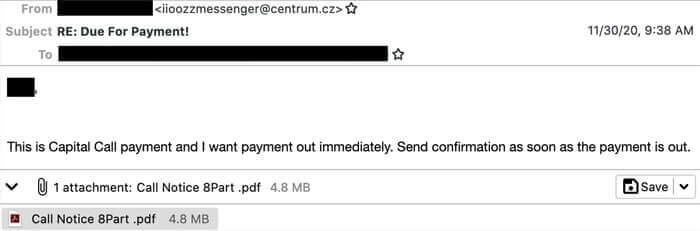
In an example shared by the researchers, the scam email attached a Capital Call Notice for US $970,357.00 to be deposited into a bank account under the fraudsters’ control.

Capital Call notice

If the targeted investor was duped into wiring the funds, then it is likely that money would be quickly moved into other accounts and withdrawn by mules to prevent the payment from being returned to the victim.

Threat researcher Crane Hassold told Bleeping Computer that the examples seen to date do not indicate that the attackers are using any inside knowledge when requesting capital call payments, but are instead referencing fictitious investments.

That suggests to me that the attackers are much less likely to succeed in their fraudulent requests than if they had hacked into investment firms and were specifically able to target investors who were expecting to receive a capital call notice at some point.

Furthermore, the attacks seen by Agari have mostly come through the Czech webmail provider Centrum, rather than making more of an effort to disguise themselves as a communication from an investment firm.

However, it is still possible for someone to be duped and potentially lose a large amount of money. And it would be a brave person indeed who betted against attackers in the future posing more successfully as an investment firm when sending out capital call scam emails, and using inside knowledge to make the social engineering much more likely to succeed.

Once again, there is a clear call for businesses to put in place both strong email security solutions and clear, strong processes to reduce the chances that funds are ever wired to fraudsters.


Editor’s Note: The opinions expressed in this guest author article are solely those of the contributor, and do not necessarily reflect those of Tripwire, Inc.

The post ” Wall Street targeted by new Capital Call investment email scammers” appeared first on TripWire

Source:TripWire – Graham Cluley

Tags: Encryption, Finance, Google, Phishing, TripWire

Continue Reading

Previous Google Will Use ‘FLoC’ for Ad Targeting Once 3rd-Party Cookies Are Dead
Next COVID-19 Vaccine Spear-Phishing Attacks Jump 26 Percent

More Stories

  • Critical Vulnerability
  • Cyber Attacks
  • Data Breach
  • Malware
  • Vulnerabilities

Asian State-Backed Group TGR-STA-1030 Breaches 70 Government, Infrastructure Entities

1 hour ago [email protected] (The Hacker News)
  • Cyber Attacks
  • Data Breach

How Samsung Knox Helps Stop Your Network Security Breach

3 hours ago [email protected] (The Hacker News)
  • Cyber Attacks
  • Data Breach
  • Malware
  • Vulnerabilities

Compromised dYdX npm and PyPI Packages Deliver Wallet Stealers and RAT Malware

5 hours ago [email protected] (The Hacker News)
  • Critical Vulnerability
  • Data Breach
  • Vulnerabilities

Claude Opus 4.6 Finds 500+ High-Severity Flaws Across Major Open-Source Libraries

8 hours ago [email protected] (The Hacker News)
  • Cyber Attacks
  • Data Breach

AISURU/Kimwolf Botnet Launches Record-Setting 31.4 Tbps DDoS Attack

20 hours ago [email protected] (The Hacker News)
  • Critical Vulnerability
  • Cyber Attacks
  • Data Breach
  • Malware
  • Vulnerabilities

ThreatsDay Bulletin: Codespaces RCE, AsyncRAT C2, BYOVD Abuse, AI Cloud Intrusions & 15+ Stories

1 day ago [email protected] (The Hacker News)

Recent Posts

  • Asian State-Backed Group TGR-STA-1030 Breaches 70 Government, Infrastructure Entities
  • How Samsung Knox Helps Stop Your Network Security Breach
  • Compromised dYdX npm and PyPI Packages Deliver Wallet Stealers and RAT Malware
  • Claude Opus 4.6 Finds 500+ High-Severity Flaws Across Major Open-Source Libraries
  • AISURU/Kimwolf Botnet Launches Record-Setting 31.4 Tbps DDoS Attack

Tags

Android APT Bug CERT Cloud Compliance Coronavirus COVID-19 Critical Severity Encryption Exploit Facebook Finance Google Google Chrome Goverment Hacker Hacker News High Severity Instagram iPhone Java Linux Low Severity Malware Medium Severity Microsoft Moderate Severity Mozzila Firefox Oracle Patch Tuesday Phishing Privacy QuickHeal Ransomware RAT Sim The Hacker News Threatpost TikTok TripWire VMWARE Vulnerability Whatsapp Zoom
Copyright © 2020 All rights reserved | NGTEdu.com
This website uses cookies to improve your experience. We'll assume you're ok with this, but you can opt-out if you wish. Read More here.Cookie settingsACCEPT
Privacy & Cookies Policy

Privacy Overview

This website uses cookies to improve your experience while you navigate through the website. Out of these cookies, the cookies that are categorized as necessary are stored on your browser as they are essential for the working of basic functionalities of the website. We also use third-party cookies that help us analyze and understand how you use this website. These cookies will be stored in your browser only with your consent. You also have the option to opt-out of these cookies. But opting out of some of these cookies may have an effect on your browsing experience.
Necessary
Always Enabled
Necessary cookies are absolutely essential for the website to function properly. This category only includes cookies that ensures basic functionalities and security features of the website. These cookies do not store any personal information.
Non-necessary
Any cookies that may not be particularly necessary for the website to function and is used specifically to collect user personal data via analytics, ads, other embedded contents are termed as non-necessary cookies. It is mandatory to procure user consent prior to running these cookies on your website.
SAVE & ACCEPT