
Skip to content
NGTEdu Logo

NGTEdu

A PRODUCT OF NGTECH.CO.IN

NGTEdu Logo

NGTEdu

  • Home
  • Cyber Attacks
  • Malware
  • Vulnerabilities
  • Data Breach
  • Home
  • Data Breach
  • VERT Research Tips: Byting into Python
  • Data Breach

VERT Research Tips: Byting into Python

4 years ago Tyler Reguly
VERT Research Tips: Byting into Python

The past few weeks, I’ve been spending a lot of my free time preparing for the OSCP exam, which means refreshing a lot of skills that I haven’t used in years. A large part of that is rebuilding muscle memory around buffer overflows, so that’s how I spent my four-day weekend. I logged about 70 hours compiling small programs, writing buffer overflows, building simple ROP chains, and honestly having a lot of fun.

When I started doing this stuff, Python 2 reigned supreme. These days, Python 3 is more common on systems, but a lot of the materials out there still reference Python 2. One of the things I noticed as I hit a wall myself early in the weekend was that there’s a bit of trickiness involved in ensuring you get the data you want out of Python 3. It was something I came across naturally due to the way I ran my code and when I started Googling, I realized that there were a lot of questions and a few stack overflow responses, but that nobody really laid it out with a detailed explanation of what was going on. So, that’s what I’m going to do … walk you through a peculiarity of Python 2 vs. Python 3 code that may have you banging your head against the wall.

To start, we’ll use msfvenom to generate shellcode and look at the differences in interacting with it:
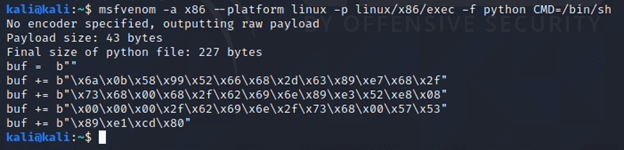
This code is then placed into a simple Python script, which we run with both Python 2 and Python 3:

Notice the difference between the hex output on our print statement. We have that familiar b’ at the start of our sequence and the ‘ at the end before the 0x0a. Our sequence has been printed out as literal characters. Instead of 0x80 (in position 2A), we now have 0x5c 0x78 0x38 0x30 (in positions 0x5C through 5F). That is significant character expansion. This definitely isn’t going to work as shellcode.

Instead of print(), however, Python 3 has a different method of sending raw bytes to the screen. We can import sys and use sys.stdout.buffer.write().

When you run these two files, you can see the improvement in the output already.

However, if you look at the two pieces of shellcode, you’ll notice that the Python 2 output is 1 byte longer. Our Python 3 output does not contain the 0x0a in position 0x2B.

The Python 2 print statement help says:

A “‘n’” character is written at the end, unless the “print” statement ends with a comma. This is the only action if the statement contains just the keyword “print”.

In order to replicate this functionality in Python 3, we need to append a single byte 0x0a to the end of our buffer.

We now have identical output between our Python 2 shellcode and our Python 3 shellcode.

There is one additional approach you can take, which is to write the contents of your shellcode to a file. You can then work directly with that file.

As I said, I noticed that a lot of people search for this, and I didn’t see a clear walkthrough, so hopefully, you found this useful.

The post ” VERT Research Tips: Byting into Python” appeared first on TripWire

Source:TripWire – Tyler Reguly

Tags: Encryption, TripWire

Continue Reading

Previous How Achieving Compliance with PCI DSS Can Help Meet GDPR Mandates
Next How to Tackle SaaS Security Misconfigurations

More Stories

  • Cyber Attacks
  • Data Breach
  • Malware
  • Vulnerabilities

German Agencies Warn of Signal Phishing Targeting Politicians, Military, Journalists

6 hours ago [email protected] (The Hacker News)
  • Critical Vulnerability
  • Cyber Attacks
  • Data Breach
  • Malware
  • Vulnerabilities

China-Linked DKnife AitM Framework Targets Routers for Traffic Hijacking, Malware Delivery

1 day ago [email protected] (The Hacker News)
  • Cyber Attacks
  • Data Breach
  • Vulnerabilities

CISA Orders Removal of Unsupported Edge Devices to Reduce Federal Network Risk

1 day ago [email protected] (The Hacker News)
  • Critical Vulnerability
  • Cyber Attacks
  • Data Breach
  • Malware
  • Vulnerabilities

Asian State-Backed Group TGR-STA-1030 Breaches 70 Government, Infrastructure Entities

1 day ago [email protected] (The Hacker News)
  • Cyber Attacks
  • Data Breach

How Samsung Knox Helps Stop Your Network Security Breach

1 day ago [email protected] (The Hacker News)
  • Cyber Attacks
  • Data Breach
  • Malware
  • Vulnerabilities

Compromised dYdX npm and PyPI Packages Deliver Wallet Stealers and RAT Malware

1 day ago [email protected] (The Hacker News)

Recent Posts

  • German Agencies Warn of Signal Phishing Targeting Politicians, Military, Journalists
  • China-Linked DKnife AitM Framework Targets Routers for Traffic Hijacking, Malware Delivery
  • CISA Orders Removal of Unsupported Edge Devices to Reduce Federal Network Risk
  • Asian State-Backed Group TGR-STA-1030 Breaches 70 Government, Infrastructure Entities
  • How Samsung Knox Helps Stop Your Network Security Breach

Tags

Android APT Bug CERT Cloud Compliance Coronavirus COVID-19 Critical Severity Encryption Exploit Facebook Finance Google Google Chrome Goverment Hacker Hacker News High Severity Instagram iPhone Java Linux Low Severity Malware Medium Severity Microsoft Moderate Severity Mozzila Firefox Oracle Patch Tuesday Phishing Privacy QuickHeal Ransomware RAT Sim The Hacker News Threatpost TikTok TripWire VMWARE Vulnerability Whatsapp Zoom
Copyright © 2020 All rights reserved | NGTEdu.com
This website uses cookies to improve your experience. We'll assume you're ok with this, but you can opt-out if you wish. Read More here.Cookie settingsACCEPT
Privacy & Cookies Policy

Privacy Overview

This website uses cookies to improve your experience while you navigate through the website. Out of these cookies, the cookies that are categorized as necessary are stored on your browser as they are essential for the working of basic functionalities of the website. We also use third-party cookies that help us analyze and understand how you use this website. These cookies will be stored in your browser only with your consent. You also have the option to opt-out of these cookies. But opting out of some of these cookies may have an effect on your browsing experience.
Necessary
Always Enabled
Necessary cookies are absolutely essential for the website to function properly. This category only includes cookies that ensures basic functionalities and security features of the website. These cookies do not store any personal information.
Non-necessary
Any cookies that may not be particularly necessary for the website to function and is used specifically to collect user personal data via analytics, ads, other embedded contents are termed as non-necessary cookies. It is mandatory to procure user consent prior to running these cookies on your website.
SAVE & ACCEPT