
Skip to content
NGTEdu Logo

NGTEdu

A PRODUCT OF NGTECH.CO.IN

NGTEdu Logo

NGTEdu

  • Home
  • Cyber Attacks
  • Malware
  • Vulnerabilities
  • Data Breach
  • Home
  • Cyber Attacks
  • Shared Responsibility and Configuration Management in the Cloud: SecTor 2020
  • Cyber Attacks
  • Data Breach
  • Vulnerabilities

Shared Responsibility and Configuration Management in the Cloud: SecTor 2020

5 years ago David Lu
Shared Responsibility and Configuration Management in the Cloud: SecTor 2020

A number of high-profile data breaches have resulted directly from misconfigured permissions or unpatched vulnerabilities. For instance, the 2017 Equifax breach was the result of exploiting an unpatched flaw in Apache Struts allowing remote code execution. More recently, the Capital One breach last year stemmed from a misconfigured web application firewall. Verizon’s 2020 DBIR reported that only hacking was more prevalent than misconfiguration errors as the culprit of data breaches.

With more and more companies moving to cloud or hybrid environments, it’s important to understand how security in the cloud works. Even though cloud providers such as Amazon Web Services, Microsoft Azure,and Google Cloud Platform offer world-class security of their infrastructure, customers of these cloud services are responsible for their share of security obligations.

For instance, AWS provides the following breakdown of shared responsibility in their documentation:
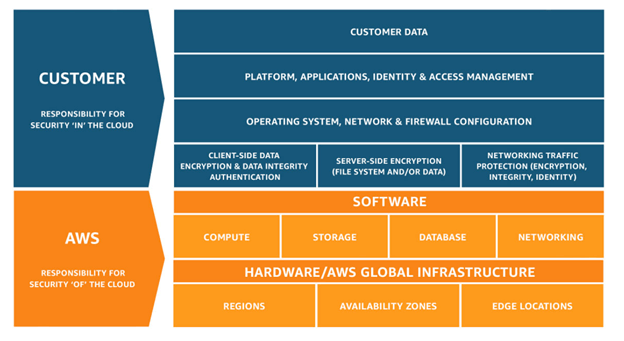
The most important distinction here is between security ‘of’ the cloud and security ‘in’ the cloud. In general, AWS is responsible for the physical infrastructure, network, database services and so on, i.e. the cloud, while customers are responsible for whatever they are doing in the cloud. However, depending on what you’re doing in the cloud, your responsibilities might not exactly follow this picture. For instance, if you’re using AWS Lambda, a server-less compute platform, then your shared responsibility picture looks like the following:

Cloud - Shared-Responsibilty-Model-LAMBDA

Notice that AWS assumes some of the security obligations from the previous breakdown. For instance, now you, the customer, no longer need to worry about network traffic and firewall configuration. These differing levels of responsibility are directly proportional to the amount of control and flexibility you want in the cloud.

Most cloud customers are not using a single service at a single level of responsibility in their deployments. In large and complex cloud environments, inconsistent configurations and patching are hard to manage manually. So, if you’re building infrastructure in the cloud, then you ought to be automating your build-out. Configuring security groups, networks, firewalls, access, encryption and so on by hand introduces opportunities for mistakes. Automation is also crucially important for checking deployments continually and for remediation.

Join me at SecTor 2020 where I’ll give an overview of shared responsibility and configuration management in the cloud.

The post ” Shared Responsibility and Configuration Management in the Cloud: SecTor 2020″ appeared first on TripWire

Source:TripWire – David Lu

Tags: Bug, Cloud, Encryption, Google, High Severity, Microsoft, TripWire, Vulnerability

Continue Reading

Previous Podcast Episode 10 – Face off: Debating Facial Recognition with Thom Langford & Paul Edon
Next Microsoft and Other Tech Companies Take Down TrickBot Botnet

More Stories

  • Cyber Attacks
  • Data Breach
  • Malware
  • Vulnerabilities

Researchers Find 341 Malicious ClawHub Skills Stealing Data from OpenClaw Users

4 hours ago [email protected] (The Hacker News)
  • Cyber Attacks
  • Data Breach
  • Vulnerabilities

OpenClaw Bug Enables One-Click Remote Code Execution via Malicious Link

5 hours ago [email protected] (The Hacker News)
  • Cyber Attacks
  • Data Breach

Microsoft Begins NTLM Phase-Out With Three-Stage Plan to Move Windows to Kerberos

6 hours ago [email protected] (The Hacker News)
  • Critical Vulnerability
  • Cyber Attacks
  • Data Breach
  • Malware
  • Vulnerabilities

⚡ Weekly Recap: Proxy Botnet, Office Zero-Day, MongoDB Ransoms, AI Hijacks & New Threats

10 hours ago [email protected] (The Hacker News)
  • Critical Vulnerability
  • Cyber Attacks
  • Data Breach

Securing the Mid-Market Across the Complete Threat Lifecycle

10 hours ago [email protected] (The Hacker News)
  • Cyber Attacks
  • Data Breach
  • Malware
  • Vulnerabilities

Notepad++ Official Update Mechanism Hijacked to Deliver Malware to Select Users

13 hours ago [email protected] (The Hacker News)

Recent Posts

  • Researchers Find 341 Malicious ClawHub Skills Stealing Data from OpenClaw Users
  • OpenClaw Bug Enables One-Click Remote Code Execution via Malicious Link
  • Microsoft Begins NTLM Phase-Out With Three-Stage Plan to Move Windows to Kerberos
  • ⚡ Weekly Recap: Proxy Botnet, Office Zero-Day, MongoDB Ransoms, AI Hijacks & New Threats
  • Securing the Mid-Market Across the Complete Threat Lifecycle

Tags

Android APT Bug CERT Cloud Compliance Coronavirus COVID-19 Critical Severity Encryption Exploit Facebook Finance Google Google Chrome Goverment Hacker Hacker News High Severity Instagram iPhone Java Linux Low Severity Malware Medium Severity Microsoft Moderate Severity Mozzila Firefox Oracle Patch Tuesday Phishing Privacy QuickHeal Ransomware RAT Sim The Hacker News Threatpost TikTok TripWire VMWARE Vulnerability Whatsapp Zoom
Copyright © 2020 All rights reserved | NGTEdu.com
This website uses cookies to improve your experience. We'll assume you're ok with this, but you can opt-out if you wish. Read More here.Cookie settingsACCEPT
Privacy & Cookies Policy

Privacy Overview

This website uses cookies to improve your experience while you navigate through the website. Out of these cookies, the cookies that are categorized as necessary are stored on your browser as they are essential for the working of basic functionalities of the website. We also use third-party cookies that help us analyze and understand how you use this website. These cookies will be stored in your browser only with your consent. You also have the option to opt-out of these cookies. But opting out of some of these cookies may have an effect on your browsing experience.
Necessary
Always Enabled
Necessary cookies are absolutely essential for the website to function properly. This category only includes cookies that ensures basic functionalities and security features of the website. These cookies do not store any personal information.
Non-necessary
Any cookies that may not be particularly necessary for the website to function and is used specifically to collect user personal data via analytics, ads, other embedded contents are termed as non-necessary cookies. It is mandatory to procure user consent prior to running these cookies on your website.
SAVE & ACCEPT