
Skip to content
NGTEdu Logo

NGTEdu

A PRODUCT OF NGTECH.CO.IN

NGTEdu Logo

NGTEdu

  • Home
  • Cyber Attacks
  • Malware
  • Vulnerabilities
  • Data Breach
  • Home
  • Data Breach
  • Phorpiex Botnet Named “Most Wanted Malware” in November 2020
  • Data Breach
  • Malware

Phorpiex Botnet Named “Most Wanted Malware” in November 2020

5 years ago David Bisson
Phorpiex Botnet Named “Most Wanted Malware” in November 2020

The Phorpiex botnet earned the notorious designation of “most wanted malware” for the month of November 2020.

In its Global Threat Index for November 2020, Check Point Research revealed that it had observed a surge in new Phorpiex botnet infections that had affected four percent of organizations globally.

This threat activity enabled Phorpiex to return to Check Point Research’s monthly malware list for the first time since June 2020. It also succeeded in pushing the threat to the top of that roundup.

Discovered in 2010, Phorpiex has a history of distributing other malware families such as GandCrab ransomware along with sextortion scams.

The attacks detected by Check Point Research involved Avaddon ransomware as the botnet’s payload. Such activity could be the result of the crypto-malware gang’s growing affiliate program. As explained by the security firm:

Avaddon is a relatively new Ransomware-as-a-Service (RaaS) variant, and its operators have again been recruiting affiliates to distribute the ransomware for a cut of the profits. Avaddon has been distributed via JS and Excel files as part of malspam campaigns and is able to encrypt a wide range of file types.

Behind Phorpiex came Dridex and Hiddad. The former is a trojan that reportedly uses spam email attachments for distribution in order to steal information off of and execute arbitrary modules on infected Windows machines. The latter is an Android threat that conceals itself within repackaged mobile apps offered on third-party app marketplaces in order to display ads to its victims.

The Global Threat Index for November 2020 found that both Phorpiex and Dridex had affected three percent of organizations globally.
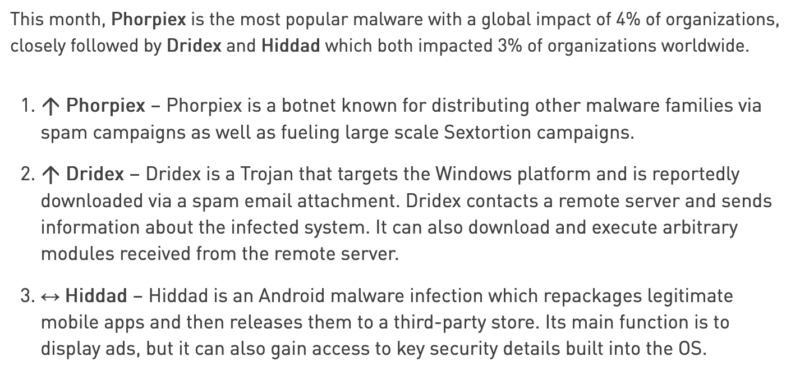
A screenshot from Check Point Research’s Global Threat Index for November 2020.

This news highlights the need for organizations to defend themselves against threats such as Phorpiex, Dridex and Hiddad.

They can do so by familiarizing themselves with some of the most common types of phishing attacks that are in circulation today and taking steps to prevent a ransomware infection. They can also invest in a solution that can help to identify suspicious files within a quarantined environment.

The post ” Phorpiex Botnet Named “Most Wanted Malware” in November 2020″ appeared first on TripWire

Source:TripWire – David Bisson

Tags: Android, Encryption, Malware, Phishing, Ransomware, TripWire

Continue Reading

Previous Amnesia:33 — Critical TCP/IP Flaws Affect Millions of IoT Devices
Next D-Link Routers at Risk for Remote Takeover from Zero-Day Flaws

More Stories

  • Cyber Attacks
  • Data Breach

Mozilla Adds One-Click Option to Disable Generative AI Features in Firefox

3 hours ago [email protected] (The Hacker News)
  • Cyber Attacks
  • Data Breach
  • Malware
  • Vulnerabilities

Notepad++ Hosting Breach Attributed to China-Linked Lotus Blossom Hacking Group

3 hours ago [email protected] (The Hacker News)
  • Cyber Attacks
  • Data Breach
  • Malware
  • Vulnerabilities

Researchers Find 341 Malicious ClawHub Skills Stealing Data from OpenClaw Users

14 hours ago [email protected] (The Hacker News)
  • Cyber Attacks
  • Data Breach
  • Vulnerabilities

OpenClaw Bug Enables One-Click Remote Code Execution via Malicious Link

16 hours ago [email protected] (The Hacker News)
  • Cyber Attacks
  • Data Breach

Microsoft Begins NTLM Phase-Out With Three-Stage Plan to Move Windows to Kerberos

16 hours ago [email protected] (The Hacker News)
  • Critical Vulnerability
  • Cyber Attacks
  • Data Breach
  • Malware
  • Vulnerabilities

⚡ Weekly Recap: Proxy Botnet, Office Zero-Day, MongoDB Ransoms, AI Hijacks & New Threats

20 hours ago [email protected] (The Hacker News)

Recent Posts

  • Mozilla Adds One-Click Option to Disable Generative AI Features in Firefox
  • Notepad++ Hosting Breach Attributed to China-Linked Lotus Blossom Hacking Group
  • Researchers Find 341 Malicious ClawHub Skills Stealing Data from OpenClaw Users
  • OpenClaw Bug Enables One-Click Remote Code Execution via Malicious Link
  • Microsoft Begins NTLM Phase-Out With Three-Stage Plan to Move Windows to Kerberos

Tags

Android APT Bug CERT Cloud Compliance Coronavirus COVID-19 Critical Severity Encryption Exploit Facebook Finance Google Google Chrome Goverment Hacker Hacker News High Severity Instagram iPhone Java Linux Low Severity Malware Medium Severity Microsoft Moderate Severity Mozzila Firefox Oracle Patch Tuesday Phishing Privacy QuickHeal Ransomware RAT Sim The Hacker News Threatpost TikTok TripWire VMWARE Vulnerability Whatsapp Zoom
Copyright © 2020 All rights reserved | NGTEdu.com
This website uses cookies to improve your experience. We'll assume you're ok with this, but you can opt-out if you wish. Read More here.Cookie settingsACCEPT
Privacy & Cookies Policy

Privacy Overview

This website uses cookies to improve your experience while you navigate through the website. Out of these cookies, the cookies that are categorized as necessary are stored on your browser as they are essential for the working of basic functionalities of the website. We also use third-party cookies that help us analyze and understand how you use this website. These cookies will be stored in your browser only with your consent. You also have the option to opt-out of these cookies. But opting out of some of these cookies may have an effect on your browsing experience.
Necessary
Always Enabled
Necessary cookies are absolutely essential for the website to function properly. This category only includes cookies that ensures basic functionalities and security features of the website. These cookies do not store any personal information.
Non-necessary
Any cookies that may not be particularly necessary for the website to function and is used specifically to collect user personal data via analytics, ads, other embedded contents are termed as non-necessary cookies. It is mandatory to procure user consent prior to running these cookies on your website.
SAVE & ACCEPT