
Skip to content
NGTEdu Logo

NGTEdu

A PRODUCT OF NGTECH.CO.IN

NGTEdu Logo

NGTEdu

  • Home
  • Cyber Attacks
  • Malware
  • Vulnerabilities
  • Data Breach
  • Home
  • Cyber Attacks
  • Phishing Campaign Leads Users to Site Disguised as Email Scanner
  • Cyber Attacks
  • Data Breach
  • Malware

Phishing Campaign Leads Users to Site Disguised as Email Scanner
5 years ago David Bisson
Phishing Campaign Leads Users to Site Disguised as Email Scanner

A phishing campaign tricked users into visiting a website that masqueraded as an email scanner in an effort to steal their account credentials.

Kaspersky Lab found that the campaign began with a scam email containing a fake virus alert.

This email claimed to originate from an organization’s “Email Security Team,” but it actually originated from a Hotmail account.

In an attempt to intimidate the recipient, the email message used a “Virus Alert” heading followed by three exclamation points.
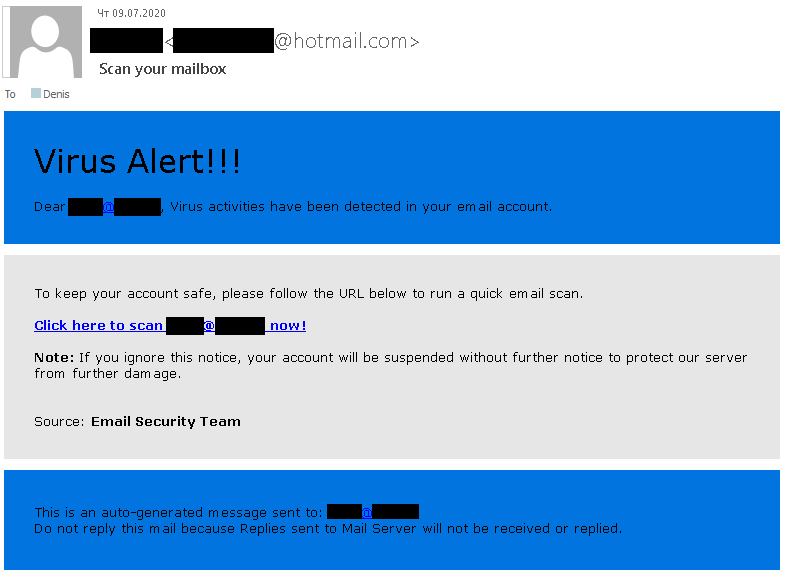
Screenshot of the scam email. (Source: Kaspersky Lab)

Researchers at the Russian security firm said this design trait was a poor choice on the attackers’ part:

However trifling punctuation may seem, it’s the first thing that should tip off the recipient that something may be wrong. Unnecessary punctuation in a work e-mail is a sign of drama or unprofessionalism. Either way, it’s inappropriate in a notification supposedly intended to convey information about a threat.

But the malicious actors didn’t stop there.

Instead, they built upon this urgency by informing the recipient that they would no longer have access to their email account unless they agreed to scan their email account by clicking on an embedded link.

Clicking on the link led the recipient to a website disguised as an email scanner. This website used the logos of several reputable antivirus providers to convince the user that it was legitimate. It also used the recipient’s email address to personalize the name of their employer in the site’s heading.

Screenshot of the fake email scanner. (Source: Kaspersky Lab)

At first, the site simulated a scan, but it interrupted this process with the message “Confirm your account below to complete Email scan & delete infected all files.” It then prompted the user to submit their email account credentials.

This attack highlights the need for organizations to protect themselves against a phishing campaign. They can do this by educating their users about some of the most common types of email-borne campaigns in circulation today.

The post ” Phishing Campaign Leads Users to Site Disguised as Email Scanner” appeared first on TripWire

Source:TripWire – David Bisson

Tags: Encryption, Malware, Phishing, TripWire

Continue Reading

Previous Black Hat 2020: ‘Zero-Click’ MacOS Exploit Chain Uses Microsoft Office Macros
Next High-Severity Cisco DoS Flaw Plagues Small-Business Switches

More Stories

  • Cyber Attacks
  • Data Breach
  • Malware
  • Vulnerabilities

Iran-Linked RedKitten Cyber Campaign Targets Human Rights NGOs and Activists

2 days ago [email protected] (The Hacker News)
  • Cyber Attacks
  • Data Breach
  • Malware
  • Vulnerabilities

Mandiant Finds ShinyHunters-Style Vishing Attacks Stealing MFA to Breach SaaS Platforms

2 days ago [email protected] (The Hacker News)
  • Cyber Attacks
  • Data Breach
  • Malware

CERT Polska Details Coordinated Cyber Attacks on 30+ Wind and Solar Farms

2 days ago [email protected] (The Hacker News)
  • Cyber Attacks
  • Data Breach
  • Malware
  • Vulnerabilities

Researchers Uncover Chrome Extensions Abusing Affiliate Links and Stealing ChatGPT Access

2 days ago [email protected] (The Hacker News)
  • Cyber Attacks
  • Data Breach
  • Malware
  • Vulnerabilities

China-Linked UAT-8099 Targets IIS Servers in Asia with BadIIS SEO Malware

3 days ago [email protected] (The Hacker News)
  • Cyber Attacks
  • Data Breach
  • Malware

Ex-Google Engineer Convicted for Stealing 2,000 AI Trade Secrets for China Startup

3 days ago [email protected] (The Hacker News)

Recent Posts

  • Iran-Linked RedKitten Cyber Campaign Targets Human Rights NGOs and Activists
  • Mandiant Finds ShinyHunters-Style Vishing Attacks Stealing MFA to Breach SaaS Platforms
  • CERT Polska Details Coordinated Cyber Attacks on 30+ Wind and Solar Farms
  • Researchers Uncover Chrome Extensions Abusing Affiliate Links and Stealing ChatGPT Access
  • China-Linked UAT-8099 Targets IIS Servers in Asia with BadIIS SEO Malware

Tags

Android APT Bug CERT Cloud Compliance Coronavirus COVID-19 Critical Severity Encryption Exploit Facebook Finance Google Google Chrome Goverment Hacker Hacker News High Severity Instagram iPhone Java Linux Low Severity Malware Medium Severity Microsoft Moderate Severity Mozzila Firefox Oracle Patch Tuesday Phishing Privacy QuickHeal Ransomware RAT Sim The Hacker News Threatpost TikTok TripWire VMWARE Vulnerability Whatsapp Zoom
Copyright © 2020 All rights reserved | NGTEdu.com
This website uses cookies to improve your experience. We'll assume you're ok with this, but you can opt-out if you wish. Read More here.Cookie settingsACCEPT
Privacy & Cookies Policy

Privacy Overview

This website uses cookies to improve your experience while you navigate through the website. Out of these cookies, the cookies that are categorized as necessary are stored on your browser as they are essential for the working of basic functionalities of the website. We also use third-party cookies that help us analyze and understand how you use this website. These cookies will be stored in your browser only with your consent. You also have the option to opt-out of these cookies. But opting out of some of these cookies may have an effect on your browsing experience.
Necessary
Always Enabled
Necessary cookies are absolutely essential for the website to function properly. This category only includes cookies that ensures basic functionalities and security features of the website. These cookies do not store any personal information.
Non-necessary
Any cookies that may not be particularly necessary for the website to function and is used specifically to collect user personal data via analytics, ads, other embedded contents are termed as non-necessary cookies. It is mandatory to procure user consent prior to running these cookies on your website.
SAVE & ACCEPT