
Skip to content
NGTEdu Logo

NGTEdu

A PRODUCT OF NGTECH.CO.IN

NGTEdu Logo

NGTEdu

  • Home
  • Cyber Attacks
  • Malware
  • Vulnerabilities
  • Data Breach
  • Home
  • Cyber Attacks
  • New ‘MontysThree’ Toolset Used in Targeted Industrial Espionage Attacks
  • Cyber Attacks
  • Data Breach
  • Malware

New ‘MontysThree’ Toolset Used in Targeted Industrial Espionage Attacks

5 years ago David Bisson
New ‘MontysThree’ Toolset Used in Targeted Industrial Espionage Attacks

Researchers uncovered a new toolset they’ve dubbed “MontysThree” that has played a role in targeted industrial espionage attacks stretching back to 2018.

In the summer of 2020, Kaspersky Lab discovered that an unknown actor had been using a modular C++ toolset called “MT3” to conduct targeted industrial espionage campaigns for years.

The security firm analyzed MT3, which they nicknamed “MontysThree,” and found that the malware relied on RAR self-extracting archives (SFX) for distribution. Those files commonly contained the names of employees’ phone lists, medical test results and technical specifications.

Ultimately, the SFX archives didn’t use any lures. All they had were PE files disguised as .PDF or .DOC files—a common technique in spear-phishing campaigns.

The researchers found that the threat didn’t break any new ground in its use of a Windows Quick Launch .lnk modifier as its persistence mechanism, in its storage of encryption keys in the same file as well as other techniques and design choices.

Even so, MontysThree stood out to Kaspersky Lab for using a custom steganography method that helped it to evade Intrusion Detection Systems (IDSes). The toolset also abused legitimate cloud services to conceal its command-and-control (C&C) traffic and stored a 3DES key under RSA encryption.

Kaspersky Lab dug a little deeper and found that whoever was responsible for developing the toolset had attempted to misdirect researchers’ attribution efforts. As quoted in the security firm’s research:

MontysThree contains natural language artifacts of proper Russian language and configuration that seek directories that exist only on Cyrilic localised Windows versions. While most external public cloud communications use token-based authorisation, some samples contain email-based accounts for them, which pretend to be a Chinese lookalike. We consider these names to be false flags. Many more artifacts suggest that the malware was developed by a Russian-speaking actor and is targeting Cyrillic Windows versions.
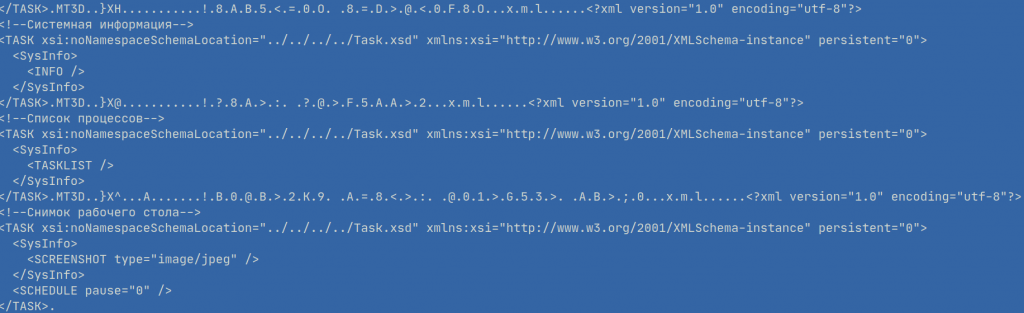
Config tasks description starts with MT3D. It contains proper short phrases written in Russian. (Source: Kaspersky Lab)

The emergence of toolsets like MontysThree highlight the need for organizations to harden the security of their industrial environments. They can do so by investing in a solution that can help to grant them visibility over their industrial networks, monitor for potential network issues, avoid plant disruptions and detect misconfigured industrial devices. Learn how Tripwire can help.

The post ” New ‘MontysThree’ Toolset Used in Targeted Industrial Espionage Attacks” appeared first on TripWire

Source:TripWire – David Bisson

Tags: Cloud, Encryption, Phishing, TripWire

Continue Reading

Previous MontysThree APT Takes Unusual Aim at Industrial Targets
Next Hackers disguise malware attack as new details on Donald Trump’s COVID-19 illness

More Stories

  • Data Breach

[Webinar] The Smarter SOC Blueprint: Learn What to Build, Buy, and Automate

5 hours ago [email protected] (The Hacker News)
  • Critical Vulnerability
  • Cyber Attacks
  • Data Breach
  • Vulnerabilities

Hackers Exploit Metro4Shell RCE Flaw in React Native CLI npm Package

6 hours ago [email protected] (The Hacker News)
  • Critical Vulnerability
  • Data Breach

When Cloud Outages Ripple Across the Internet

9 hours ago [email protected] (The Hacker News)
  • Cyber Attacks
  • Data Breach
  • Malware
  • Vulnerabilities

APT28 Uses Microsoft Office CVE-2026-21509 in Espionage-Focused Malware Attacks

10 hours ago [email protected] (The Hacker News)
  • Cyber Attacks
  • Data Breach

Mozilla Adds One-Click Option to Disable Generative AI Features in Firefox

14 hours ago [email protected] (The Hacker News)
  • Cyber Attacks
  • Data Breach
  • Malware
  • Vulnerabilities

Notepad++ Hosting Breach Attributed to China-Linked Lotus Blossom Hacking Group

15 hours ago [email protected] (The Hacker News)

Recent Posts

  • http://thehackernews.com/2026/02/docker-fixes-critical-ask-gordon-ai.html
  • [Webinar] The Smarter SOC Blueprint: Learn What to Build, Buy, and Automate
  • Hackers Exploit Metro4Shell RCE Flaw in React Native CLI npm Package
  • When Cloud Outages Ripple Across the Internet
  • APT28 Uses Microsoft Office CVE-2026-21509 in Espionage-Focused Malware Attacks

Tags

Android APT Bug CERT Cloud Compliance Coronavirus COVID-19 Critical Severity Encryption Exploit Facebook Finance Google Google Chrome Goverment Hacker Hacker News High Severity Instagram iPhone Java Linux Low Severity Malware Medium Severity Microsoft Moderate Severity Mozzila Firefox Oracle Patch Tuesday Phishing Privacy QuickHeal Ransomware RAT Sim The Hacker News Threatpost TikTok TripWire VMWARE Vulnerability Whatsapp Zoom
Copyright © 2020 All rights reserved | NGTEdu.com
This website uses cookies to improve your experience. We'll assume you're ok with this, but you can opt-out if you wish. Read More here.Cookie settingsACCEPT
Privacy & Cookies Policy

Privacy Overview

This website uses cookies to improve your experience while you navigate through the website. Out of these cookies, the cookies that are categorized as necessary are stored on your browser as they are essential for the working of basic functionalities of the website. We also use third-party cookies that help us analyze and understand how you use this website. These cookies will be stored in your browser only with your consent. You also have the option to opt-out of these cookies. But opting out of some of these cookies may have an effect on your browsing experience.
Necessary
Always Enabled
Necessary cookies are absolutely essential for the website to function properly. This category only includes cookies that ensures basic functionalities and security features of the website. These cookies do not store any personal information.
Non-necessary
Any cookies that may not be particularly necessary for the website to function and is used specifically to collect user personal data via analytics, ads, other embedded contents are termed as non-necessary cookies. It is mandatory to procure user consent prior to running these cookies on your website.
SAVE & ACCEPT