
Skip to content
NGTEdu Logo

NGTEdu

A PRODUCT OF NGTECH.CO.IN

NGTEdu Logo

NGTEdu

  • Home
  • Cyber Attacks
  • Malware
  • Vulnerabilities
  • Data Breach
  • Home
  • Cyber Attacks
  • How Social Norms Can Be Exploited by Scammers on Social Media
  • Cyber Attacks
  • Data Breach
  • Vulnerabilities

How Social Norms Can Be Exploited by Scammers on Social Media
5 years ago Martina Dove
How Social Norms Can Be Exploited by Scammers on Social Media

Social media platforms are excellent hunting grounds for scammers. This is where we connect with our friends or people who we have something in common with. This is precisely what scammers exploit—our connections and the trust that is afforded between friends or acquaintances.

From an early age, we are taught to be kind and compassionate as well as to help others, especially people we know such as friends and family. In turn, they will help us if we ever need it. This is a socially desired behavior.

Most people think and operate in this way. But this is also how we can be exploited by scammers. Look at the following real-life case study of a common Facebook scam that targets the friends of a victim’s compromised account.
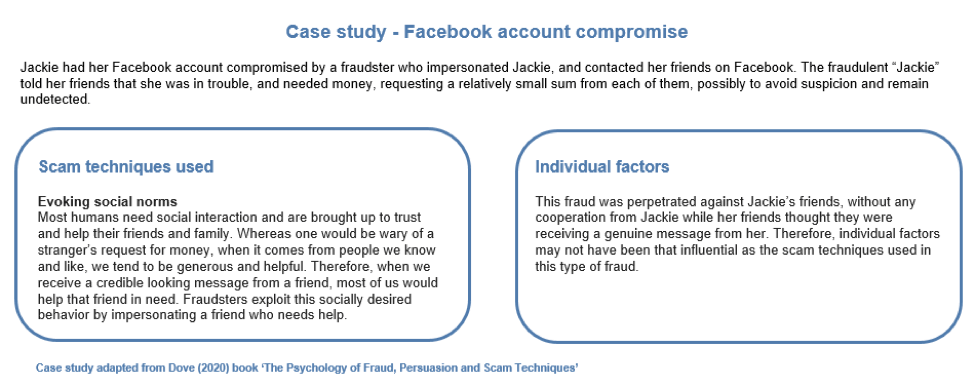
Although this scam was perpetrated against Jackie’s Facebook friends, there is still something Jackie could have done to prevent this scam. While we cannot control how social media companies protect our data from cybercriminals, we can still do something to make it hard for cybercriminals to fraudulently use our data. Make sure you use strong, unique passwords for all of your logins with the help of a good password manager. This measure is important because if a scammer gets hold of your account log in details and you use the same password on your social media account that is used on our email, the intruder can easily log in to both accounts. This means that any login alerts sent by a social media account will be intercepted. Using the same password for multiple accounts also means that the scammer may compromise your other accounts. The fraudulent login process would also be interrupted if there is a two-factor authentication method enabled on your accounts.

If you are a ‘friend’ who has just received a strange message from one of your friends on a social media platform, you would be wise to double-check the information given. Call the person who has sent you the request on their phone to verify the information. If you are unable to do so, you can try getting verification some other way. For example, you can try asking a question that only the person would know how to answer. Or try asking a trick question – something you know is not an accurate fact about the friend in question – to see how they respond. Then watch for vague responses or avoidance to answer the question. This can often raise red flags that something is not right.

It is also important to understand that many scams exploit our kindness and good nature. There are plenty of fundraising campaigns on social media, and many are not genuine. It is always recommended to get into the habit of checking facts before transferring funds.

Here are some other tips on how to stay safe on social media.

More articles that may interest you:

Phishing attacks often target small businesses – here’s what to watch for

Protecting a New Vulnerable Population on the Internet

Protecting the New Most Vulnerable Population – The Grandparent Scam

Protecting the New Most Vulnerable Population – Subscription Scams

The post ” How Social Norms Can Be Exploited by Scammers on Social Media” appeared first on TripWire

Source:TripWire – Martina Dove

Tags: Encryption, Exploit, Facebook, Phishing, TripWire

Continue Reading

Previous Black Hat: New CISA Head Woos Crowd With Public-Private Task Force
Next VMware Issues Patches to Fix Critical Bugs Affecting Multiple Products

More Stories

  • Cyber Attacks
  • Data Breach
  • Malware
  • Vulnerabilities

German Agencies Warn of Signal Phishing Targeting Politicians, Military, Journalists

6 hours ago [email protected] (The Hacker News)
  • Critical Vulnerability
  • Cyber Attacks
  • Data Breach
  • Malware
  • Vulnerabilities

China-Linked DKnife AitM Framework Targets Routers for Traffic Hijacking, Malware Delivery

1 day ago [email protected] (The Hacker News)
  • Cyber Attacks
  • Data Breach
  • Vulnerabilities

CISA Orders Removal of Unsupported Edge Devices to Reduce Federal Network Risk

1 day ago [email protected] (The Hacker News)
  • Critical Vulnerability
  • Cyber Attacks
  • Data Breach
  • Malware
  • Vulnerabilities

Asian State-Backed Group TGR-STA-1030 Breaches 70 Government, Infrastructure Entities

1 day ago [email protected] (The Hacker News)
  • Cyber Attacks
  • Data Breach

How Samsung Knox Helps Stop Your Network Security Breach

1 day ago [email protected] (The Hacker News)
  • Cyber Attacks
  • Data Breach
  • Malware
  • Vulnerabilities

Compromised dYdX npm and PyPI Packages Deliver Wallet Stealers and RAT Malware

1 day ago [email protected] (The Hacker News)

Recent Posts

  • German Agencies Warn of Signal Phishing Targeting Politicians, Military, Journalists
  • China-Linked DKnife AitM Framework Targets Routers for Traffic Hijacking, Malware Delivery
  • CISA Orders Removal of Unsupported Edge Devices to Reduce Federal Network Risk
  • Asian State-Backed Group TGR-STA-1030 Breaches 70 Government, Infrastructure Entities
  • How Samsung Knox Helps Stop Your Network Security Breach

Tags

Android APT Bug CERT Cloud Compliance Coronavirus COVID-19 Critical Severity Encryption Exploit Facebook Finance Google Google Chrome Goverment Hacker Hacker News High Severity Instagram iPhone Java Linux Low Severity Malware Medium Severity Microsoft Moderate Severity Mozzila Firefox Oracle Patch Tuesday Phishing Privacy QuickHeal Ransomware RAT Sim The Hacker News Threatpost TikTok TripWire VMWARE Vulnerability Whatsapp Zoom
Copyright © 2020 All rights reserved | NGTEdu.com
This website uses cookies to improve your experience. We'll assume you're ok with this, but you can opt-out if you wish. Read More here.Cookie settingsACCEPT
Privacy & Cookies Policy

Privacy Overview

This website uses cookies to improve your experience while you navigate through the website. Out of these cookies, the cookies that are categorized as necessary are stored on your browser as they are essential for the working of basic functionalities of the website. We also use third-party cookies that help us analyze and understand how you use this website. These cookies will be stored in your browser only with your consent. You also have the option to opt-out of these cookies. But opting out of some of these cookies may have an effect on your browsing experience.
Necessary
Always Enabled
Necessary cookies are absolutely essential for the website to function properly. This category only includes cookies that ensures basic functionalities and security features of the website. These cookies do not store any personal information.
Non-necessary
Any cookies that may not be particularly necessary for the website to function and is used specifically to collect user personal data via analytics, ads, other embedded contents are termed as non-necessary cookies. It is mandatory to procure user consent prior to running these cookies on your website.
SAVE & ACCEPT