
Skip to content
NGTEdu Logo

NGTEdu

A PRODUCT OF NGTECH.CO.IN

NGTEdu Logo

NGTEdu

  • Home
  • Cyber Attacks
  • Malware
  • Vulnerabilities
  • Data Breach
  • Home
  • Cyber Attacks
  • Google App Engine, Azure App Service Abused in Phishing Campaign
  • Cyber Attacks
  • Data Breach

Google App Engine, Azure App Service Abused in Phishing Campaign

6 years ago David Bisson
Google App Engine, Azure App Service Abused in Phishing Campaign

A phishing campaign abused both the Google App Engine and the Azure App Service to steal victims’ Microsoft Outlook credentials.

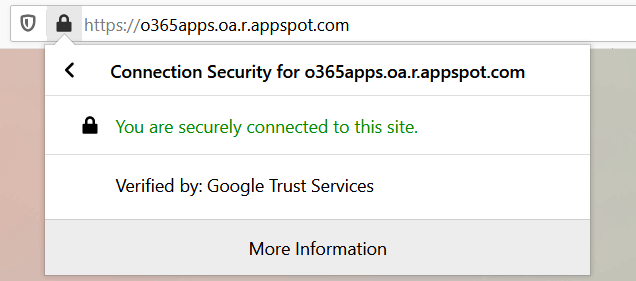
Netskope observed that the attack campaign started with a shortened link “https://bitly[.]com/33nMLkZ” distributed by a phishing email. This link redirected a recipient of the email to a Google App Engine domain “https://o365apps[.]oa.r.appspot.com.”

A Google Cloud Platform (GCP) service used for developing and hosting web applications, Google App Engine enables customers to direct SSL-protected traffic through their appspot.com domain.

This characteristic thereby lent the domain used in this campaign a sense of legitimacy.
Phishing page hosted in appspot.com. (Source: Netskope)

At the time of Netskope’s analysis, https://o365apps[.]oa.r.appspot.com served as the location for a phishing page that prompted visitors to submit their Microsoft Outlook credentials.

The phishing page informed the visitor that their account credentials were incorrect after they had submitted their username and password. It then sent those details to ‘handler.php,’ a page hosted via Azure’s App Service at “july-28[.].azurewebsites[.]net.”

This domain was one of 110 bait URLs and 72 credential hosting URLs that traced back to this phishing campaign. As noted by Netskope, however, the vast majority of those sites used Azure’s App Service:

…[T]he threat actor has mostly used Azure App Service to host the credential harvester at azurewebistes.net. It appears the attacker tried out multiple different options to serve the credential harvester and chose to use Azure App Service on an ongoing basis, likely because of its ease of use and Microsoft-issued SSL certs.

Credential hosted domains. (Source: Netskope)

The campaign described above highlights the need for organizations to defend themselves against a phishing attack. One of the ways they can do this is by training their employees to spot some of the most common types of phishing campaigns that are in circulation today. They can use this resource to lay the basis for their education efforts.

The post ” Google App Engine, Azure App Service Abused in Phishing Campaign” appeared first on TripWire

Source:TripWire – David Bisson

Tags: Cloud, Encryption, Google, Microsoft, Phishing, TripWire

Continue Reading

Previous Citrix Warns of Critical Flaws in XenMobile Server
Next Cybercriminals Are Infiltrating Netgear Routers with Ancient Attack Methods

More Stories

  • Cyber Attacks
  • Data Breach
  • Vulnerabilities

FBI Warns Russian Hackers Target Signal, WhatsApp in Mass Phishing Attacks

1 day ago [email protected] (The Hacker News)
  • Critical Vulnerability
  • Cyber Attacks
  • Data Breach
  • Vulnerabilities

Oracle Patches Critical CVE-2026-21992 Enabling Unauthenticated RCE in Identity Manager

2 days ago [email protected] (The Hacker News)
  • Critical Vulnerability
  • Cyber Attacks
  • Data Breach
  • Malware
  • Vulnerabilities

CISA Flags Apple, Craft CMS, Laravel Bugs in KEV, Orders Patching by April 3, 2026

2 days ago [email protected] (The Hacker News)
  • Cyber Attacks
  • Data Breach
  • Malware

Trivy Supply Chain Attack Triggers Self-Spreading CanisterWorm Across 47 npm Packages

2 days ago [email protected] (The Hacker News)
  • Cyber Attacks
  • Data Breach
  • Malware
  • Vulnerabilities

Trivy Security Scanner GitHub Actions Breached, 75 Tags Hijacked to Steal CI/CD Secrets

2 days ago [email protected] (The Hacker News)
  • Critical Vulnerability
  • Cyber Attacks
  • Data Breach
  • Malware
  • Vulnerabilities

Critical Langflow Flaw CVE-2026-33017 Triggers Attacks within 20 Hours of Disclosure

2 days ago [email protected] (The Hacker News)

Recent Posts

  • FBI Warns Russian Hackers Target Signal, WhatsApp in Mass Phishing Attacks
  • Oracle Patches Critical CVE-2026-21992 Enabling Unauthenticated RCE in Identity Manager
  • CISA Flags Apple, Craft CMS, Laravel Bugs in KEV, Orders Patching by April 3, 2026
  • Trivy Supply Chain Attack Triggers Self-Spreading CanisterWorm Across 47 npm Packages
  • Trivy Security Scanner GitHub Actions Breached, 75 Tags Hijacked to Steal CI/CD Secrets

Tags

Android APT Bug CERT Cloud Compliance Coronavirus COVID-19 Critical Severity Encryption Exploit Facebook Finance Google Google Chrome Goverment Hacker Hacker News High Severity Instagram iPhone Java Linux Low Severity Malware Medium Severity Microsoft Moderate Severity Mozzila Firefox Oracle Patch Tuesday Phishing Privacy QuickHeal Ransomware RAT Sim The Hacker News Threatpost TikTok TripWire VMWARE Vulnerability Whatsapp Zoom
Copyright © 2020 All rights reserved | NGTEdu.com
This website uses cookies to improve your experience. We'll assume you're ok with this, but you can opt-out if you wish. Read More here.Cookie settingsACCEPT
Privacy & Cookies Policy

Privacy Overview

This website uses cookies to improve your experience while you navigate through the website. Out of these cookies, the cookies that are categorized as necessary are stored on your browser as they are essential for the working of basic functionalities of the website. We also use third-party cookies that help us analyze and understand how you use this website. These cookies will be stored in your browser only with your consent. You also have the option to opt-out of these cookies. But opting out of some of these cookies may have an effect on your browsing experience.
Necessary
Always Enabled
Necessary cookies are absolutely essential for the website to function properly. This category only includes cookies that ensures basic functionalities and security features of the website. These cookies do not store any personal information.
Non-necessary
Any cookies that may not be particularly necessary for the website to function and is used specifically to collect user personal data via analytics, ads, other embedded contents are termed as non-necessary cookies. It is mandatory to procure user consent prior to running these cookies on your website.
SAVE & ACCEPT