
Skip to content
NGTEdu Logo

NGTEdu

A PRODUCT OF NGTECH.CO.IN

NGTEdu Logo

NGTEdu

  • Home
  • Cyber Attacks
  • Malware
  • Vulnerabilities
  • Data Breach
  • Home
  • Cyber Attacks
  • Gift Cards Requested in Two-Thirds of BEC Attacks, Report Reveals
  • Cyber Attacks
  • Data Breach

Gift Cards Requested in Two-Thirds of BEC Attacks, Report Reveals

5 years ago David Bisson
Gift Cards Requested in Two-Thirds of BEC Attacks, Report Reveals

A report revealed that scammers requested funds in the form of gift cards in two-thirds of business email compromise (BEC) attacks.

For a phishing trends report from the Anti-Phishing Working Group (APWG), APWG member Agari examined thousands of BEC attacks that occurred in the second half of 2020. It found that 66% of them involved gift cards. By contrast, direct bank transfers factored in just 18% of attacks, followed close behind by payroll diversions at 16%.

The amount of money requested by scammers varied according to these means of attack. Agari discovered that the average BEC wire transfer attempt was $80,183–up from $54,000 the previous quarter. By contrast, scammers requested an average of $1,213 in attacks involving gift cards. That was down from about $1,453 in the first quarter of the year.

APWG feels that these smaller asks in the form of gift cards might have benefited scammers. As it explained in its report:

Scam attempts around this dollar amount may have a decent chance of success, because they can be approved by multiple people in a medium-to-large company, and the amount is small enough to slip by some companies’ financial controls. Gift cards for eBay, Google Play, Apple iTunes, and Steam Walletmade up 70percentof gift card requests in the second quarter.

Agari found that 72% of BEC attacks sent in Q2 2020 emanated from free webmail attacks. (That was up from 61% the previous quarter.) Half of those attacks came from Gmail accounts.
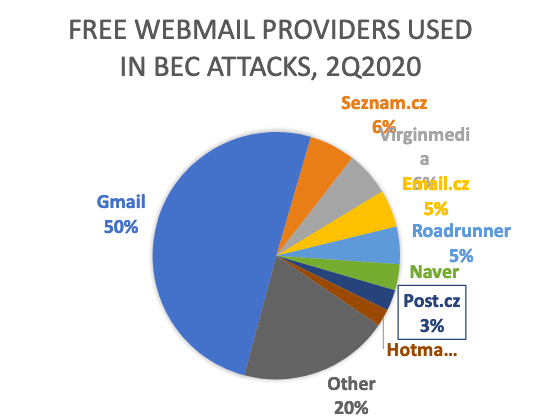
APWG’s “Phishing Activity Trends Report: 2nd Quarter 2020,” page 7

These findings arrive approximately one year after the Federal Bureau of Investigation (FBI) revealed that BEC scams cost victims a combined total of $26 billion in losses over a three-year period.

The report from APWG serves as a reminder for organizations to strengthen their defenses against a BEC attack. One of the ways they can do this is by educating their employees about some of the most common phishing attacks that are in circulation today.

The post ” Gift Cards Requested in Two-Thirds of BEC Attacks, Report Reveals” appeared first on TripWire

Source:TripWire – David Bisson

Tags: Encryption, Finance, Google, Medium Severity, Phishing, TripWire

Continue Reading

Previous Cisco Issues Warning Over IOS XR Zero-Day Flaw Being Targeted in the Wild
Next FBI: Ring Smart Doorbells Could Sabotage Cops

More Stories

  • Cyber Attacks
  • Data Breach

AISURU/Kimwolf Botnet Launches Record-Setting 31.4 Tbps DDoS Attack

4 hours ago [email protected] (The Hacker News)
  • Critical Vulnerability
  • Cyber Attacks
  • Data Breach
  • Malware
  • Vulnerabilities

ThreatsDay Bulletin: Codespaces RCE, AsyncRAT C2, BYOVD Abuse, AI Cloud Intrusions & 15+ Stories

9 hours ago [email protected] (The Hacker News)
  • Data Breach

The Buyer’s Guide to AI Usage Control

10 hours ago [email protected] (The Hacker News)
  • Cyber Attacks
  • Data Breach
  • Malware
  • Vulnerabilities

Infy Hackers Resume Operations with New C2 Servers After Iran Internet Blackout Ends

11 hours ago [email protected] (The Hacker News)
  • Critical Vulnerability
  • Cyber Attacks
  • Data Breach
  • Vulnerabilities

Critical n8n Flaw CVE-2026-25049 Enables System Command Execution via Malicious Workflows

15 hours ago [email protected] (The Hacker News)
  • Critical Vulnerability
  • Cyber Attacks
  • Data Breach
  • Vulnerabilities

Malicious NGINX Configurations Enable Large-Scale Web Traffic Hijacking Campaign

17 hours ago [email protected] (The Hacker News)

Recent Posts

  • AISURU/Kimwolf Botnet Launches Record-Setting 31.4 Tbps DDoS Attack
  • ThreatsDay Bulletin: Codespaces RCE, AsyncRAT C2, BYOVD Abuse, AI Cloud Intrusions & 15+ Stories
  • The Buyer’s Guide to AI Usage Control
  • Infy Hackers Resume Operations with New C2 Servers After Iran Internet Blackout Ends
  • Critical n8n Flaw CVE-2026-25049 Enables System Command Execution via Malicious Workflows

Tags

Android APT Bug CERT Cloud Compliance Coronavirus COVID-19 Critical Severity Encryption Exploit Facebook Finance Google Google Chrome Goverment Hacker Hacker News High Severity Instagram iPhone Java Linux Low Severity Malware Medium Severity Microsoft Moderate Severity Mozzila Firefox Oracle Patch Tuesday Phishing Privacy QuickHeal Ransomware RAT Sim The Hacker News Threatpost TikTok TripWire VMWARE Vulnerability Whatsapp Zoom
Copyright © 2020 All rights reserved | NGTEdu.com
This website uses cookies to improve your experience. We'll assume you're ok with this, but you can opt-out if you wish. Read More here.Cookie settingsACCEPT
Privacy & Cookies Policy

Privacy Overview

This website uses cookies to improve your experience while you navigate through the website. Out of these cookies, the cookies that are categorized as necessary are stored on your browser as they are essential for the working of basic functionalities of the website. We also use third-party cookies that help us analyze and understand how you use this website. These cookies will be stored in your browser only with your consent. You also have the option to opt-out of these cookies. But opting out of some of these cookies may have an effect on your browsing experience.
Necessary
Always Enabled
Necessary cookies are absolutely essential for the website to function properly. This category only includes cookies that ensures basic functionalities and security features of the website. These cookies do not store any personal information.
Non-necessary
Any cookies that may not be particularly necessary for the website to function and is used specifically to collect user personal data via analytics, ads, other embedded contents are termed as non-necessary cookies. It is mandatory to procure user consent prior to running these cookies on your website.
SAVE & ACCEPT