
Skip to content
NGTEdu Logo

NGTEdu

A PRODUCT OF NGTECH.CO.IN

NGTEdu Logo

NGTEdu

  • Home
  • Cyber Attacks
  • Malware
  • Vulnerabilities
  • Data Breach
  • Home
  • Data Breach
  • Ghidra 101: Decoding Stack Strings
  • Data Breach

Ghidra 101: Decoding Stack Strings

5 years ago Craig Young
Ghidra 101: Decoding Stack Strings

In this blog series, I will be putting the spotlight on some useful Ghidra features you might have missed. Each post will look at a different feature and show how it helps you save time and be more effective in your reverse engineering workflows. Ghidra is an incredibly powerful tool, but much of this power comes from knowing how to use it effectively.

In this post, I’ll be discussing how to use the Ghidra Decompiler to identify strings being constructed on the stack at runtime. This stack string technique is an easy way for a programmer to obscure string data within a program by blending it as opaque operand instructions. A typical pattern for constructing a stack string would be a series of MOV instructions transferring constant values into adjacent locations on the stack as shown in these basic examples:
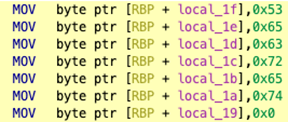
Single Byte Copies
DWORD-copies
DWORD Copies

The above examples as seen in the Decompiler:

decompiler-single-byte-copies
Single Byte Copies
decompiler-DWORD-copies
DWORD Copies

Decoding Stack Strings

Some stack strings can be identified or deciphered with simple operations in the Decompiler view. In the case of the single byte copies, it may be possible to read out stack string values by updating Ghidra’s stack frame description so that the individual opaque bytes are interpreted as elements in a character array. The easiest way to do this is to retype the earliest element from undefined to char[n] where n is the length of the reconstructed string.

retype-variable
data-type-chooser-dialog

The resulting changes in the Decompiler reveal the string clearly:

Stack String in Decompiler

DWORD Value Previews

This is an easy way to evaluate that simple example, but it is not so trivial to convert multibyte stack string construction. In this case, it is possible to glimpse the data through the data type preview which appears when mousing over the constants.

Preview of 0x72636553
Preview of 0x217465
Preview of 0x217465

 Scripted Analysis

While these techniques can work, they are lacking in robustness and may lead to confusion related to endianness or complicated strings. Fortunately, Ghidra includes a script, SimpleStackString.py, for dealing with these examples.

To use the script:

  1. Set the cursor to the first line of the stack string construction.
  2. Open the Script Manager window and filter for ‘stack.’
  3. Select SimpleStackString.py and click the ‘Run Script’ button.
  4. Output is logged to the Console and added in Comments.

Example output from using the SimpleStackString.py script on a MalwareTech Blog challenge is shown below:

Example output from simple stack string

Keep in mind, however, that this script is rather limited and will fail in some scenarios as shown here when parsing the DWORD copy example above:

simple stack string

The analyzed program would actually read out ‘Secret!,’ but the script apparently didn’t correctly infer the byte order which jumbled the string. The BBBB above was actually adjacent data in the program that was misinterpreted because the null-termination was missed or otherwise ignored.

Further Challenges

An evasive developer can do a lot to hinder our ability to recognize and decode stack strings via static analysis. The writes which construct the stack string may be executed in any order, interleaved with functional code or further obfuscated with decoy writes or encodings. In cases where static recovery of stack strings is highly tedious, it may be more appropriate to consider dynamic analysis techniques such as running the code or sections of the code within a debugger or emulator. This is not currently supported in Ghidra, but it has been one of the most hotly anticipated upcoming features teased by the NSA, and a recently pushed ‘debugger’ branch on GitHub finally makes this feature available for early testing. Within that branch, there is also a note in the developer’s guide that emulation will become an integral feature of the UI, as well. In time, these features could certainly simplify the process of recovering obfuscated functionality from compiled code. 

Read More about Ghidra

Ghidra 101: Cursor Text Highlighting

Ghidra 101: Slice Highlighting

The post ” Ghidra 101: Decoding Stack Strings” appeared first on TripWire

Source:TripWire – Craig Young

Tags: Encryption, TripWire

Continue Reading

Previous What Does Data Privacy Mean to Consumers and Corporations?
Next In the Wake of the SolarWinds Hack, Here’s How Businesses Should Respond

More Stories

  • Cyber Attacks
  • Data Breach

How Samsung Knox Helps Stop Your Network Security Breach

1 hour ago [email protected] (The Hacker News)
  • Cyber Attacks
  • Data Breach
  • Malware
  • Vulnerabilities

Compromised dYdX npm and PyPI Packages Deliver Wallet Stealers and RAT Malware

3 hours ago [email protected] (The Hacker News)
  • Critical Vulnerability
  • Data Breach
  • Vulnerabilities

Claude Opus 4.6 Finds 500+ High-Severity Flaws Across Major Open-Source Libraries

6 hours ago [email protected] (The Hacker News)
  • Cyber Attacks
  • Data Breach

AISURU/Kimwolf Botnet Launches Record-Setting 31.4 Tbps DDoS Attack

18 hours ago [email protected] (The Hacker News)
  • Critical Vulnerability
  • Cyber Attacks
  • Data Breach
  • Malware
  • Vulnerabilities

ThreatsDay Bulletin: Codespaces RCE, AsyncRAT C2, BYOVD Abuse, AI Cloud Intrusions & 15+ Stories

23 hours ago [email protected] (The Hacker News)
  • Data Breach

The Buyer’s Guide to AI Usage Control

1 day ago [email protected] (The Hacker News)

Recent Posts

  • How Samsung Knox Helps Stop Your Network Security Breach
  • Compromised dYdX npm and PyPI Packages Deliver Wallet Stealers and RAT Malware
  • Claude Opus 4.6 Finds 500+ High-Severity Flaws Across Major Open-Source Libraries
  • AISURU/Kimwolf Botnet Launches Record-Setting 31.4 Tbps DDoS Attack
  • ThreatsDay Bulletin: Codespaces RCE, AsyncRAT C2, BYOVD Abuse, AI Cloud Intrusions & 15+ Stories

Tags

Android APT Bug CERT Cloud Compliance Coronavirus COVID-19 Critical Severity Encryption Exploit Facebook Finance Google Google Chrome Goverment Hacker Hacker News High Severity Instagram iPhone Java Linux Low Severity Malware Medium Severity Microsoft Moderate Severity Mozzila Firefox Oracle Patch Tuesday Phishing Privacy QuickHeal Ransomware RAT Sim The Hacker News Threatpost TikTok TripWire VMWARE Vulnerability Whatsapp Zoom
Copyright © 2020 All rights reserved | NGTEdu.com
This website uses cookies to improve your experience. We'll assume you're ok with this, but you can opt-out if you wish. Read More here.Cookie settingsACCEPT
Privacy & Cookies Policy

Privacy Overview

This website uses cookies to improve your experience while you navigate through the website. Out of these cookies, the cookies that are categorized as necessary are stored on your browser as they are essential for the working of basic functionalities of the website. We also use third-party cookies that help us analyze and understand how you use this website. These cookies will be stored in your browser only with your consent. You also have the option to opt-out of these cookies. But opting out of some of these cookies may have an effect on your browsing experience.
Necessary
Always Enabled
Necessary cookies are absolutely essential for the website to function properly. This category only includes cookies that ensures basic functionalities and security features of the website. These cookies do not store any personal information.
Non-necessary
Any cookies that may not be particularly necessary for the website to function and is used specifically to collect user personal data via analytics, ads, other embedded contents are termed as non-necessary cookies. It is mandatory to procure user consent prior to running these cookies on your website.
SAVE & ACCEPT