
Skip to content
NGTEdu Logo

NGTEdu

A PRODUCT OF NGTECH.CO.IN

NGTEdu Logo

NGTEdu

  • Home
  • Cyber Attacks
  • Malware
  • Vulnerabilities
  • Data Breach
  • Home
  • Cyber Attacks
  • Federal agencies given five days to find hacked Exchange servers
  • Cyber Attacks
  • Data Breach
  • Malware
  • Vulnerabilities

Federal agencies given five days to find hacked Exchange servers
5 years ago Graham Cluley
Federal agencies given five days to find hacked Exchange servers

CISA, the US Department of Homeland Security’s Cybersecurity and Infrastructure Security Agency, has told federal agencies that they have until 12:00pm EDT on Monday April 5 to scan their networks for evidence of intrusion by malicious actors, and report back the results.

CISA is ordering agencies with on-premises Microsoft Exchange servers to urgently conduct the scans following widespread exploitation of vulnerabilities, in fear that some compromises may have remained undetected.

In an updated directive, CISA has directed federal departments and agencies to download and run the latest version of Microsoft’s scanning tool (known as MSERT).

Agencies have also been told that every week, for four weeks after the first scan, the latest version of MSERT should be downloaded and run again, and any findings that indicate compromise must be reported to CISA.

Because a full scan with MSERT can take several hours and be a drag on server resources, agencies are advised to run the tool during off-peak hours.

In addition, and by the same April 5 deadline, agencies are being told to download and run Microsoft’s Test-ProxyLogon.ps1 script. The script analyses Exchange and IIS logs, indicating potential attacker activity.
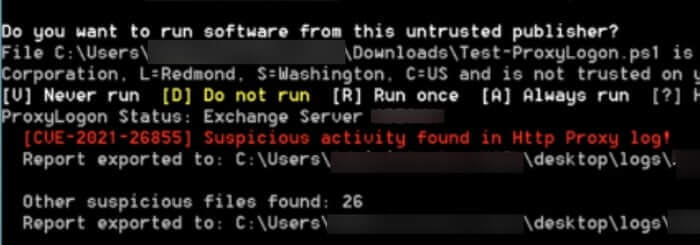
Again, CISA is requesting that reports from the script be shared with them.

Lastly, CISA is calling upon all agencies to harden the defences of their on-premises Microsoft Exchange servers by 12:00pm EDT on Monday, June 28 2021. This includes provisioning firewalls, installing security updates within 48 hours of release, using only software that is still officially supported by a vendor, installing anti-virus software on Exchange servers and keeping it current, capturing and storing logs, and reviewing users’ permissions and roles.

CISA says it has identified that some federal agencies are still operating Microsoft Exchange servers that require additional hardening.

Of course, if all this advice makes good security sense for federal agencies and departments then it’s hard to argue that it doesn’t also make sense for private sector companies and other organisations.

Every organisation at risk should be considering taking similar steps to ensure that they too have not been compromised by the attacks against Microsoft Exchange Server.


Editor’s Note: The opinions expressed in this guest author article are solely those of the contributor, and do not necessarily reflect those of Tripwire, Inc.

The post ” Federal agencies given five days to find hacked Exchange servers” appeared first on TripWire

Source:TripWire – Graham Cluley

Tags: Encryption, Goverment, Malware, Microsoft, TripWire

Continue Reading

Previous DeepDotWeb Admin Pleads Guilty to Money Laundering Charges
Next Google: North Korean APT Gearing Up to Target Security Researchers Again

More Stories

  • Cyber Attacks
  • Data Breach
  • Malware
  • Vulnerabilities

German Agencies Warn of Signal Phishing Targeting Politicians, Military, Journalists

20 hours ago [email protected] (The Hacker News)
  • Critical Vulnerability
  • Cyber Attacks
  • Data Breach
  • Malware
  • Vulnerabilities

China-Linked DKnife AitM Framework Targets Routers for Traffic Hijacking, Malware Delivery

2 days ago [email protected] (The Hacker News)
  • Cyber Attacks
  • Data Breach
  • Vulnerabilities

CISA Orders Removal of Unsupported Edge Devices to Reduce Federal Network Risk

2 days ago [email protected] (The Hacker News)
  • Critical Vulnerability
  • Cyber Attacks
  • Data Breach
  • Malware
  • Vulnerabilities

Asian State-Backed Group TGR-STA-1030 Breaches 70 Government, Infrastructure Entities

2 days ago [email protected] (The Hacker News)
  • Cyber Attacks
  • Data Breach

How Samsung Knox Helps Stop Your Network Security Breach

2 days ago [email protected] (The Hacker News)
  • Cyber Attacks
  • Data Breach
  • Malware
  • Vulnerabilities

Compromised dYdX npm and PyPI Packages Deliver Wallet Stealers and RAT Malware

2 days ago [email protected] (The Hacker News)

Recent Posts

  • German Agencies Warn of Signal Phishing Targeting Politicians, Military, Journalists
  • China-Linked DKnife AitM Framework Targets Routers for Traffic Hijacking, Malware Delivery
  • CISA Orders Removal of Unsupported Edge Devices to Reduce Federal Network Risk
  • Asian State-Backed Group TGR-STA-1030 Breaches 70 Government, Infrastructure Entities
  • How Samsung Knox Helps Stop Your Network Security Breach

Tags

Android APT Bug CERT Cloud Compliance Coronavirus COVID-19 Critical Severity Encryption Exploit Facebook Finance Google Google Chrome Goverment Hacker Hacker News High Severity Instagram iPhone Java Linux Low Severity Malware Medium Severity Microsoft Moderate Severity Mozzila Firefox Oracle Patch Tuesday Phishing Privacy QuickHeal Ransomware RAT Sim The Hacker News Threatpost TikTok TripWire VMWARE Vulnerability Whatsapp Zoom
Copyright © 2020 All rights reserved | NGTEdu.com
This website uses cookies to improve your experience. We'll assume you're ok with this, but you can opt-out if you wish. Read More here.Cookie settingsACCEPT
Privacy & Cookies Policy

Privacy Overview

This website uses cookies to improve your experience while you navigate through the website. Out of these cookies, the cookies that are categorized as necessary are stored on your browser as they are essential for the working of basic functionalities of the website. We also use third-party cookies that help us analyze and understand how you use this website. These cookies will be stored in your browser only with your consent. You also have the option to opt-out of these cookies. But opting out of some of these cookies may have an effect on your browsing experience.
Necessary
Always Enabled
Necessary cookies are absolutely essential for the website to function properly. This category only includes cookies that ensures basic functionalities and security features of the website. These cookies do not store any personal information.
Non-necessary
Any cookies that may not be particularly necessary for the website to function and is used specifically to collect user personal data via analytics, ads, other embedded contents are termed as non-necessary cookies. It is mandatory to procure user consent prior to running these cookies on your website.
SAVE & ACCEPT