
Skip to content
NGTEdu Logo

NGTEdu

A PRODUCT OF NGTECH.CO.IN

NGTEdu Logo

NGTEdu

  • Home
  • Cyber Attacks
  • Malware
  • Vulnerabilities
  • Data Breach
  • Home
  • Cyber Attacks
  • Extortionists Preying on Site Owners with Fake Website Hacking Scam
  • Critical Vulnerability
  • Cyber Attacks
  • Data Breach
  • Malware

Extortionists Preying on Site Owners with Fake Website Hacking Scam

6 years ago David Bisson
Extortionists Preying on Site Owners with Fake Website Hacking Scam

Researchers found that extortionists are targeting website owners with a scam in which they claim to have hacked their site and extracted a database.

WebARX observed that the ploy first makes itself known to website owners when they receive a ransom message from the attackers.

In a sample note analyzed by the web application security platform, the scammers claimed that they compromised the recipient’s website and extracted the site’s database. They then told the recipient that they intended to either leak the site’s data online or sell it in an auction unless they received a ransom payment from their victims. That ransom demand ranged in amount from 1500 USD and 3000 USD.
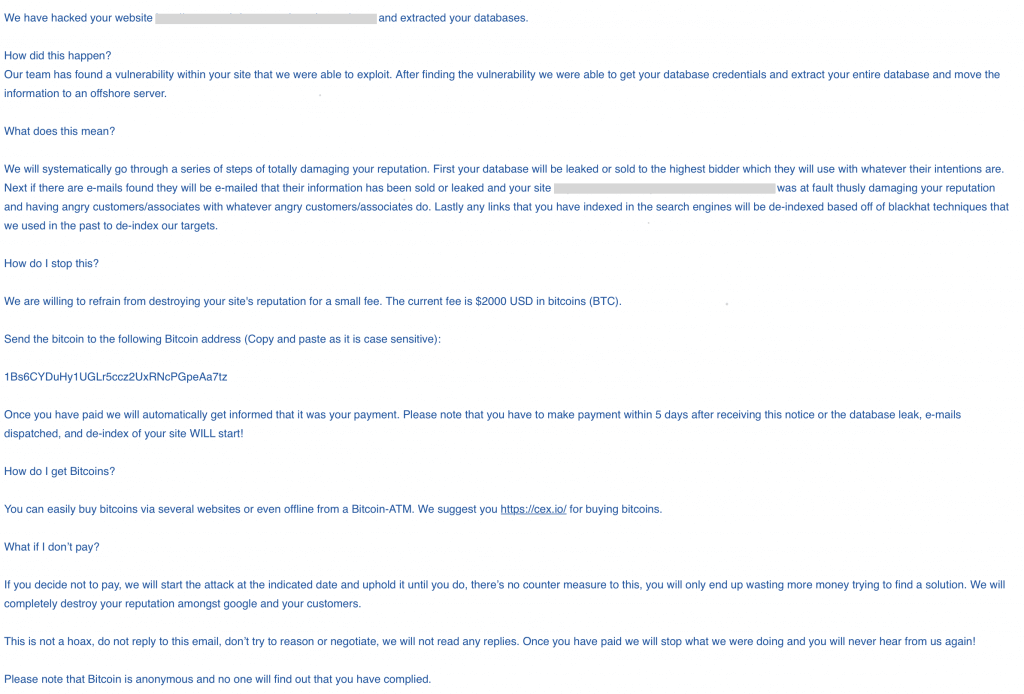
Sample ransom message (Source: WebARX)

The attackers went on to threaten their use of black-hat SEO techniques to ruin non-compliant recipients’ website rankings.

Those responsible for penning the ransom note discussed above did not offer any proof to support their claims. That’s because they did not have any. The attack which they described never occurred; they were merely using recipients’ fear against them in an attempt to trick them into paying.

Given this observation, WebARX recommended that website owners resist reacting out of fear and instead ask themselves some questions to figure out if a threat made by extortionists is legitimate. As the platform explained its research:

Ask yourself, is there any proof of these claims? Does that email contain any information that could indicate that the website is compromised and that the database breached? What kind of information is there in the database? Does it even have a database? Critical questions as such often give you a quick reality check if this is something you should worry about.

Website site owners should also take additional steps to protect themselves against a malware infection, a distributed denial-of-service (DDoS) campaign and other common digital threats. This resource is a great place to start.

The post ” Extortionists Preying on Site Owners with Fake Website Hacking Scam” appeared first on TripWire

Source:TripWire – David Bisson

Tags: Critical Severity, Encryption, TripWire

Continue Reading

Previous WebAuthn Passwordless Authentication Now Available for Atlassian Products
Next New Mobile Internet Protocol Vulnerabilities Let Hackers Target 4G/5G Users

More Stories

  • Cyber Attacks
  • Data Breach
  • Malware
  • Vulnerabilities

Iran-Linked RedKitten Cyber Campaign Targets Human Rights NGOs and Activists

1 day ago [email protected] (The Hacker News)
  • Cyber Attacks
  • Data Breach
  • Malware
  • Vulnerabilities

Mandiant Finds ShinyHunters-Style Vishing Attacks Stealing MFA to Breach SaaS Platforms

1 day ago [email protected] (The Hacker News)
  • Cyber Attacks
  • Data Breach
  • Malware

CERT Polska Details Coordinated Cyber Attacks on 30+ Wind and Solar Farms

1 day ago [email protected] (The Hacker News)
  • Cyber Attacks
  • Data Breach
  • Malware
  • Vulnerabilities

Researchers Uncover Chrome Extensions Abusing Affiliate Links and Stealing ChatGPT Access

2 days ago [email protected] (The Hacker News)
  • Cyber Attacks
  • Data Breach
  • Malware
  • Vulnerabilities

China-Linked UAT-8099 Targets IIS Servers in Asia with BadIIS SEO Malware

2 days ago [email protected] (The Hacker News)
  • Cyber Attacks
  • Data Breach
  • Malware

Ex-Google Engineer Convicted for Stealing 2,000 AI Trade Secrets for China Startup

2 days ago [email protected] (The Hacker News)

Recent Posts

  • Iran-Linked RedKitten Cyber Campaign Targets Human Rights NGOs and Activists
  • Mandiant Finds ShinyHunters-Style Vishing Attacks Stealing MFA to Breach SaaS Platforms
  • CERT Polska Details Coordinated Cyber Attacks on 30+ Wind and Solar Farms
  • Researchers Uncover Chrome Extensions Abusing Affiliate Links and Stealing ChatGPT Access
  • China-Linked UAT-8099 Targets IIS Servers in Asia with BadIIS SEO Malware

Tags

Android APT Bug CERT Cloud Compliance Coronavirus COVID-19 Critical Severity Encryption Exploit Facebook Finance Google Google Chrome Goverment Hacker Hacker News High Severity Instagram iPhone Java Linux Low Severity Malware Medium Severity Microsoft Moderate Severity Mozzila Firefox Oracle Patch Tuesday Phishing Privacy QuickHeal Ransomware RAT Sim The Hacker News Threatpost TikTok TripWire VMWARE Vulnerability Whatsapp Zoom
Copyright © 2020 All rights reserved | NGTEdu.com
This website uses cookies to improve your experience. We'll assume you're ok with this, but you can opt-out if you wish. Read More here.Cookie settingsACCEPT
Privacy & Cookies Policy

Privacy Overview

This website uses cookies to improve your experience while you navigate through the website. Out of these cookies, the cookies that are categorized as necessary are stored on your browser as they are essential for the working of basic functionalities of the website. We also use third-party cookies that help us analyze and understand how you use this website. These cookies will be stored in your browser only with your consent. You also have the option to opt-out of these cookies. But opting out of some of these cookies may have an effect on your browsing experience.
Necessary
Always Enabled
Necessary cookies are absolutely essential for the website to function properly. This category only includes cookies that ensures basic functionalities and security features of the website. These cookies do not store any personal information.
Non-necessary
Any cookies that may not be particularly necessary for the website to function and is used specifically to collect user personal data via analytics, ads, other embedded contents are termed as non-necessary cookies. It is mandatory to procure user consent prior to running these cookies on your website.
SAVE & ACCEPT