
Skip to content
NGTEdu Logo

NGTEdu

A PRODUCT OF NGTECH.CO.IN

NGTEdu Logo

NGTEdu

  • Home
  • Cyber Attacks
  • Malware
  • Vulnerabilities
  • Data Breach
  • Home
  • Cyber Attacks
  • CISA Warns of Phishing Emails Leading to Spoofed COVID-19 Relief Page
  • Cyber Attacks
  • Data Breach

CISA Warns of Phishing Emails Leading to Spoofed COVID-19 Relief Page
6 years ago David Bisson
CISA Warns of Phishing Emails Leading to Spoofed COVID-19 Relief Page

The Cybersecurity & Infrastructure Security Agency (CISA) warned that phishing emails are redirecting recipients to spoofed COVID-19 loan relief pages.

On August 12, CISA announced its discovery of the attack campaign in Alert (AA20-225A):

The Cybersecurity and Infrastructure Security Agency (CISA) is currently tracking an unknown malicious cyber actor who is spoofing the Small Business Administration (SBA) COVID-19 loan relief webpage via phishing emails. These emails include a malicious link to the spoofed SBA website that the cyber actor is using for malicious re-directs and credential stealing.

CISA went on to explain that individuals at multiple Federal Civilian Executive Branch and state, local, tribal and territorial government had received the attack emails.

Using the subject line “SBA Application – Review and Proceed,” the emails informed recipients that they could apply and/or review their application for a COVID-19 relief loan via the Small Business Association (SBA) by clicking on an embedded link. This resource redirected them to “hxxps://leanproconsulting[.]com.br/gov/covid19relief/sba.gov,” a domain which resolved to the IP address 162.214.104[.]246.

That domain was the home to a fake SBA loan relief login portal at the time of CISA’s analysis.
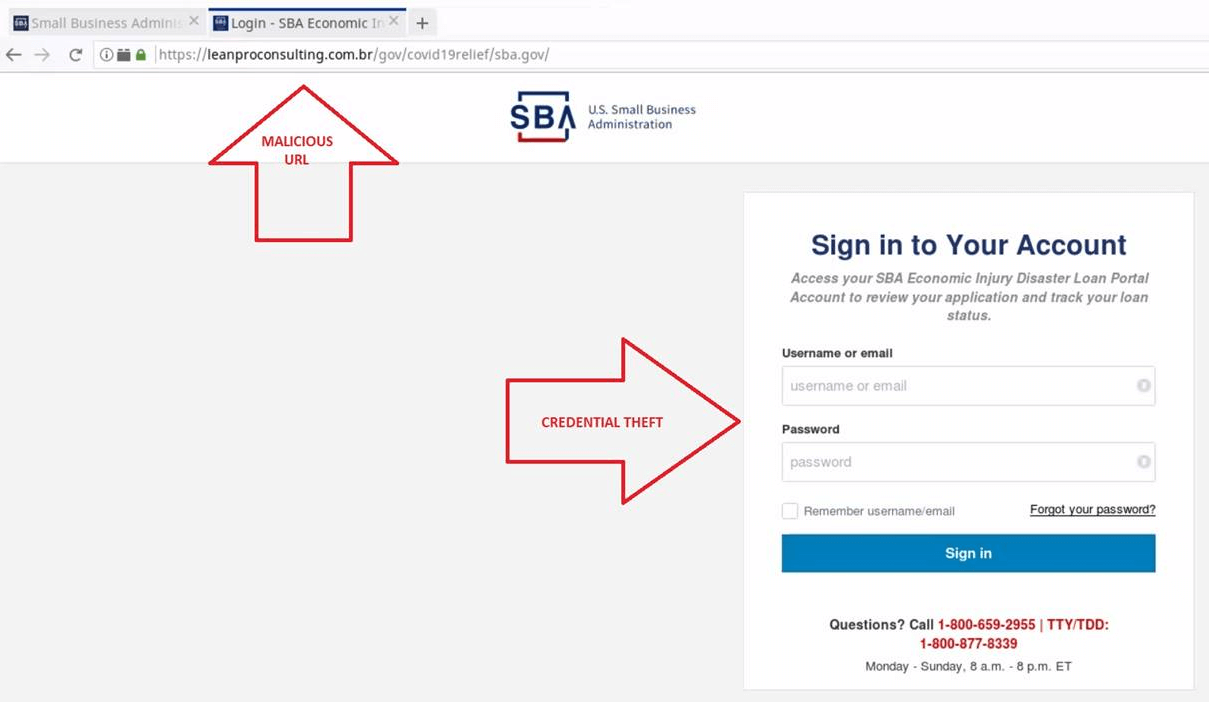
Webpage arrived at via malicious hyperlink. (Source: CISA)

The attack described above wasn’t the first time that scammers abused COVID-19 economic relief for nefarious purposes. Back in mid-March, malicious actors sent out scam emails informing recipients that they could collect a $1,000 economic stimulus check by providing their personal information, banking details and Social Security Numbers. This information gave attackers all they needed to perpetrate identity fraud against their victims.

In response to the phishing emails it observed, CISA recommended that organizations implement banners for all emails that originate from outside their network, maintain up-to-date antivirus solutions and enforce a strong password policy.

They should also consider educating their employees about some of the most common phishing campaigns and techniques that are in circulation today. They can use this resource to get started.

The post ” CISA Warns of Phishing Emails Leading to Spoofed COVID-19 Relief Page” appeared first on TripWire

Source:TripWire – David Bisson

Tags: CERT, COVID-19, Encryption, Goverment, Phishing, TripWire

Continue Reading

Previous Amazon Alexa ‘One-Click’ Attack Can Divulge Personal Data
Next High-Severity TinyMCE Cross-Site Scripting Flaw Fixed

More Stories

  • Cyber Attacks
  • Data Breach
  • Malware
  • Vulnerabilities

Trivy Security Scanner GitHub Actions Breached, 75 Tags Hijacked to Steal CI/CD Secrets

2 hours ago [email protected] (The Hacker News)
  • Critical Vulnerability
  • Cyber Attacks
  • Data Breach
  • Malware
  • Vulnerabilities

Critical Langflow Flaw CVE-2026-33017 Triggers Attacks within 20 Hours of Disclosure

4 hours ago [email protected] (The Hacker News)
  • Cyber Attacks
  • Data Breach
  • Malware

Google Adds 24-Hour Wait for Unverified App Sideloading to Reduce Malware and Scams

8 hours ago [email protected] (The Hacker News)
  • Critical Vulnerability
  • Cyber Attacks
  • Data Breach
  • Malware
  • Vulnerabilities

The Importance of Behavioral Analytics in AI-Enabled Cyber Attacks

9 hours ago [email protected] (The Hacker News)
  • Critical Vulnerability
  • Cyber Attacks
  • Data Breach
  • Malware
  • Vulnerabilities

Magento PolyShell Flaw Enables Unauthenticated Uploads, RCE and Account Takeover

10 hours ago [email protected] (The Hacker News)
  • Cyber Attacks
  • Data Breach
  • Malware

DoJ Disrupts 3 Million-Device IoT Botnets Behind Record 31.4 Tbps Global DDoS Attacks

13 hours ago [email protected] (The Hacker News)

Recent Posts

  • Trivy Security Scanner GitHub Actions Breached, 75 Tags Hijacked to Steal CI/CD Secrets
  • Critical Langflow Flaw CVE-2026-33017 Triggers Attacks within 20 Hours of Disclosure
  • Google Adds 24-Hour Wait for Unverified App Sideloading to Reduce Malware and Scams
  • The Importance of Behavioral Analytics in AI-Enabled Cyber Attacks
  • Magento PolyShell Flaw Enables Unauthenticated Uploads, RCE and Account Takeover

Tags

Android APT Bug CERT Cloud Compliance Coronavirus COVID-19 Critical Severity Encryption Exploit Facebook Finance Google Google Chrome Goverment Hacker Hacker News High Severity Instagram iPhone Java Linux Low Severity Malware Medium Severity Microsoft Moderate Severity Mozzila Firefox Oracle Patch Tuesday Phishing Privacy QuickHeal Ransomware RAT Sim The Hacker News Threatpost TikTok TripWire VMWARE Vulnerability Whatsapp Zoom
Copyright © 2020 All rights reserved | NGTEdu.com
This website uses cookies to improve your experience. We'll assume you're ok with this, but you can opt-out if you wish. Read More here.Cookie settingsACCEPT
Privacy & Cookies Policy

Privacy Overview

This website uses cookies to improve your experience while you navigate through the website. Out of these cookies, the cookies that are categorized as necessary are stored on your browser as they are essential for the working of basic functionalities of the website. We also use third-party cookies that help us analyze and understand how you use this website. These cookies will be stored in your browser only with your consent. You also have the option to opt-out of these cookies. But opting out of some of these cookies may have an effect on your browsing experience.
Necessary
Always Enabled
Necessary cookies are absolutely essential for the website to function properly. This category only includes cookies that ensures basic functionalities and security features of the website. These cookies do not store any personal information.
Non-necessary
Any cookies that may not be particularly necessary for the website to function and is used specifically to collect user personal data via analytics, ads, other embedded contents are termed as non-necessary cookies. It is mandatory to procure user consent prior to running these cookies on your website.
SAVE & ACCEPT