
Skip to content
NGTEdu Logo

NGTEdu

A PRODUCT OF NGTECH.CO.IN

NGTEdu Logo

NGTEdu

  • Home
  • Cyber Attacks
  • Malware
  • Vulnerabilities
  • Data Breach
  • Home
  • Cyber Attacks
  • BlackRock Android Banking Malware Targeting 337 Mobile Apps
  • Cyber Attacks
  • Data Breach
  • Malware

BlackRock Android Banking Malware Targeting 337 Mobile Apps

6 years ago David Bisson
BlackRock Android Banking Malware Targeting 337 Mobile Apps

Security researchers discovered a new Android banking malware family called “BlackRock” that targets 337 mobile applications.

ThreatFabric found that BlackRock hid its icon when it first launched itself on a mobile device. It then posed as a Google update in an attempt to gain access to a user’s Accessibility Service. Once it received access to these privileges, the malware granted itself additional permissions that enabled it to communicate with its command-and-control (C&C) server and to perform overlay attacks.

At this stage in its infection chain, BlackRock checked to see which app was running in the foreground on the infected device. The Android malware then had the option of deploying one of two types of overlays: a generic credit card grabber or an overlay that specifically mimicked one of 337 applications that appeared on the threat’s target lists.

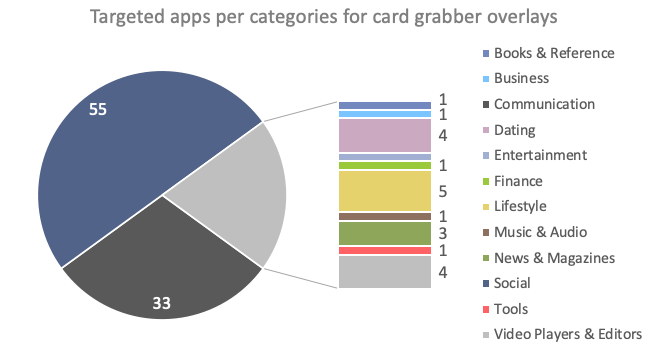
In analyzing BlackRock’s target list, ThreatFabric found that the majority of apps related to banking operations in Europe followed by Australia, the United States and then Canada. Even so, the security firm found that the banking malware also went after social, communication, lifestyle and even dating programs.

As it explained in its research:

Most of the trending social and dating apps are included, the actors’ choice might have been driven by the pandemic situation, pushing people to socialized more online. It also seems that actors have made a particular effort on including dating apps, which wasn’t something common in targets list so far.
Source: ThreatFabric

According to ThreatFabric’s analysis, BlackRock arrived as the latest attempt by malicious actors to revive LokiBot. This threat first appeared on the threat landscape in 2016 and 2017 with various attack campaigns, including one in which it deployed ransomware if a user attempted to remove it. LokiBot died down after its source code appeared online, though it was involved in some attack operations as recently as May 2019.

The emergence of BlackRock highlights the need for organizations to defend themselves against mobile banking malware by downloading apps only from trusted developers on official app marketplaces, keeping an eye out for apps that require excessive permissions and protecting their banking accounts with some form of multi-factor authentication.

The post ” BlackRock Android Banking Malware Targeting 337 Mobile Apps” appeared first on TripWire

Source:TripWire – David Bisson

Tags: Android, Encryption, Google, Malware, Ransomware, TripWire

Continue Reading

Previous Amazon-Themed Phishing Campaigns Swim Past Security Checks
Next Zoom Addresses Vanity URL Zero-Day

More Stories

  • Critical Vulnerability
  • Cyber Attacks
  • Data Breach
  • Malware
  • Vulnerabilities

⚡ Weekly Recap: CI/CD Backdoor, FBI Buys Location Data, WhatsApp Ditches Numbers & More

4 hours ago [email protected] (The Hacker News)
  • Critical Vulnerability
  • Cyber Attacks
  • Data Breach
  • Vulnerabilities

We Found Eight Attack Vectors Inside AWS Bedrock. Here’s What Attackers Can Do with Them

5 hours ago [email protected] (The Hacker News)
  • Cyber Attacks
  • Data Breach
  • Malware

Microsoft Warns IRS Phishing Hits 29,000 Users, Deploys RMM Malware

6 hours ago [email protected] (The Hacker News)
  • Critical Vulnerability
  • Cyber Attacks
  • Data Breach
  • Malware
  • Vulnerabilities

Trivy Hack Spreads Infostealer via Docker, Triggers Worm and Kubernetes Wiper

8 hours ago [email protected] (The Hacker News)
  • Cyber Attacks
  • Data Breach
  • Vulnerabilities

Hackers Exploit CVE-2025-32975 (CVSS 10.0) to Hijack Unpatched Quest KACE SMA Systems

11 hours ago [email protected] (The Hacker News)
  • Cyber Attacks
  • Data Breach
  • Vulnerabilities

FBI Warns Russian Hackers Target Signal, WhatsApp in Mass Phishing Attacks

2 days ago [email protected] (The Hacker News)

Recent Posts

  • ⚡ Weekly Recap: CI/CD Backdoor, FBI Buys Location Data, WhatsApp Ditches Numbers & More
  • We Found Eight Attack Vectors Inside AWS Bedrock. Here’s What Attackers Can Do with Them
  • Microsoft Warns IRS Phishing Hits 29,000 Users, Deploys RMM Malware
  • Trivy Hack Spreads Infostealer via Docker, Triggers Worm and Kubernetes Wiper
  • Hackers Exploit CVE-2025-32975 (CVSS 10.0) to Hijack Unpatched Quest KACE SMA Systems

Tags

Android APT Bug CERT Cloud Compliance Coronavirus COVID-19 Critical Severity Encryption Exploit Facebook Finance Google Google Chrome Goverment Hacker Hacker News High Severity Instagram iPhone Java Linux Low Severity Malware Medium Severity Microsoft Moderate Severity Mozzila Firefox Oracle Patch Tuesday Phishing Privacy QuickHeal Ransomware RAT Sim The Hacker News Threatpost TikTok TripWire VMWARE Vulnerability Whatsapp Zoom
Copyright © 2020 All rights reserved | NGTEdu.com
This website uses cookies to improve your experience. We'll assume you're ok with this, but you can opt-out if you wish. Read More here.Cookie settingsACCEPT
Privacy & Cookies Policy

Privacy Overview

This website uses cookies to improve your experience while you navigate through the website. Out of these cookies, the cookies that are categorized as necessary are stored on your browser as they are essential for the working of basic functionalities of the website. We also use third-party cookies that help us analyze and understand how you use this website. These cookies will be stored in your browser only with your consent. You also have the option to opt-out of these cookies. But opting out of some of these cookies may have an effect on your browsing experience.
Necessary
Always Enabled
Necessary cookies are absolutely essential for the website to function properly. This category only includes cookies that ensures basic functionalities and security features of the website. These cookies do not store any personal information.
Non-necessary
Any cookies that may not be particularly necessary for the website to function and is used specifically to collect user personal data via analytics, ads, other embedded contents are termed as non-necessary cookies. It is mandatory to procure user consent prior to running these cookies on your website.
SAVE & ACCEPT