
Skip to content
NGTEdu Logo

NGTEdu

A PRODUCT OF NGTECH.CO.IN

NGTEdu Logo

NGTEdu

  • Home
  • Cyber Attacks
  • Malware
  • Vulnerabilities
  • Data Breach
  • Home
  • Cyber Attacks
  • Back-to-Work Phishing Campaign Targeting Corporate Email Accounts
  • Cyber Attacks
  • Data Breach

Back-to-Work Phishing Campaign Targeting Corporate Email Accounts

5 years ago David Bisson
Back-to-Work Phishing Campaign Targeting Corporate Email Accounts

A phishing campaign used what appeared to be back-to-work notifications in order to compromise recipients’ corporate email accounts.

Near the end of November, Abnormal Security detected one of the campaign’s attack emails. That message masqueraded as an internal notification from the recipient’s company. It did so by using spoofing techniques to disguise the sender address.

The email didn’t originate from inside the company, however. As Abnormal Security explained in its research:

… [T]he sender’s actual address is ‘[email protected]’, an otherwise unknown party. Further, the IP originates from a blacklisted VPN service that is not consistent with the corporate IP. This indicates the sender is impersonating the automated internal system.

Using these techniques, the phishing email attempted to trick the recipient into thinking they had received a voicemail and that a callback was requested.
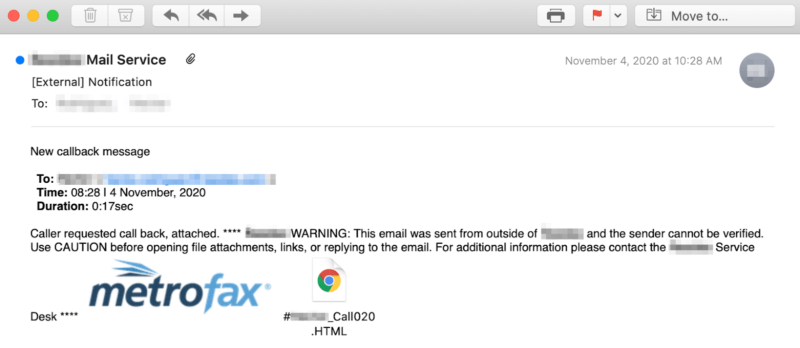
A screenshot of the attack email. (Source: Abnormal Security)

That email instructed the recipient to open an HTML attachment containing the recipient’s name in its title.

When opened, that document appeared to lay out new instructions for the targeted company’s remote work policy. It also included a link that urged users to submit their acknowledgment of the updated terms. In reality, it sent them to a fake login page designed to steal their email credentials.

A screenshot of the HTML attachment. (Source: Abnormal Security)

If the user attempted to authenticate themselves, the fake login portal sent their credentials over to the attackers.

Those malicious actors could have then used those details in an attempt to access the targeted company’s sensitive data.

At the time of Abnormal Security’s discovery, this phishing campaign had bypassed G Suite’s email security tools and landed in as many as 100,000 employees inboxes.

This campaign highlights the need for organizations to protect their employees’ corporate email accounts against phishers. One of the ways they can do this is by educating their users about some of the most common types of phishing attacks that are in circulation today. This resource is a good place to start.

The post ” Back-to-Work Phishing Campaign Targeting Corporate Email Accounts” appeared first on TripWire

Source:TripWire – David Bisson

Tags: Encryption, Phishing, TripWire

Continue Reading

Previous Hacking Christmas Gifts: Putting IoT Under the Microscope
Next Quick Guide — How to Troubleshoot Active Directory Account Lockouts

More Stories

  • Cyber Attacks
  • Data Breach

AISURU/Kimwolf Botnet Launches Record-Setting 31.4 Tbps DDoS Attack

9 hours ago [email protected] (The Hacker News)
  • Critical Vulnerability
  • Cyber Attacks
  • Data Breach
  • Malware
  • Vulnerabilities

ThreatsDay Bulletin: Codespaces RCE, AsyncRAT C2, BYOVD Abuse, AI Cloud Intrusions & 15+ Stories

14 hours ago [email protected] (The Hacker News)
  • Data Breach

The Buyer’s Guide to AI Usage Control

15 hours ago [email protected] (The Hacker News)
  • Cyber Attacks
  • Data Breach
  • Malware
  • Vulnerabilities

Infy Hackers Resume Operations with New C2 Servers After Iran Internet Blackout Ends

16 hours ago [email protected] (The Hacker News)
  • Critical Vulnerability
  • Cyber Attacks
  • Data Breach
  • Vulnerabilities

Critical n8n Flaw CVE-2026-25049 Enables System Command Execution via Malicious Workflows

21 hours ago [email protected] (The Hacker News)
  • Critical Vulnerability
  • Cyber Attacks
  • Data Breach
  • Vulnerabilities

Malicious NGINX Configurations Enable Large-Scale Web Traffic Hijacking Campaign

22 hours ago [email protected] (The Hacker News)

Recent Posts

  • AISURU/Kimwolf Botnet Launches Record-Setting 31.4 Tbps DDoS Attack
  • ThreatsDay Bulletin: Codespaces RCE, AsyncRAT C2, BYOVD Abuse, AI Cloud Intrusions & 15+ Stories
  • The Buyer’s Guide to AI Usage Control
  • Infy Hackers Resume Operations with New C2 Servers After Iran Internet Blackout Ends
  • Critical n8n Flaw CVE-2026-25049 Enables System Command Execution via Malicious Workflows

Tags

Android APT Bug CERT Cloud Compliance Coronavirus COVID-19 Critical Severity Encryption Exploit Facebook Finance Google Google Chrome Goverment Hacker Hacker News High Severity Instagram iPhone Java Linux Low Severity Malware Medium Severity Microsoft Moderate Severity Mozzila Firefox Oracle Patch Tuesday Phishing Privacy QuickHeal Ransomware RAT Sim The Hacker News Threatpost TikTok TripWire VMWARE Vulnerability Whatsapp Zoom
Copyright © 2020 All rights reserved | NGTEdu.com
This website uses cookies to improve your experience. We'll assume you're ok with this, but you can opt-out if you wish. Read More here.Cookie settingsACCEPT
Privacy & Cookies Policy

Privacy Overview

This website uses cookies to improve your experience while you navigate through the website. Out of these cookies, the cookies that are categorized as necessary are stored on your browser as they are essential for the working of basic functionalities of the website. We also use third-party cookies that help us analyze and understand how you use this website. These cookies will be stored in your browser only with your consent. You also have the option to opt-out of these cookies. But opting out of some of these cookies may have an effect on your browsing experience.
Necessary
Always Enabled
Necessary cookies are absolutely essential for the website to function properly. This category only includes cookies that ensures basic functionalities and security features of the website. These cookies do not store any personal information.
Non-necessary
Any cookies that may not be particularly necessary for the website to function and is used specifically to collect user personal data via analytics, ads, other embedded contents are termed as non-necessary cookies. It is mandatory to procure user consent prior to running these cookies on your website.
SAVE & ACCEPT