
Skip to content
NGTEdu Logo

NGTEdu

A PRODUCT OF NGTECH.CO.IN

NGTEdu Logo

NGTEdu

  • Home
  • Cyber Attacks
  • Malware
  • Vulnerabilities
  • Data Breach
  • Home
  • Cyber Attacks
  • Attack Misuses Google Docs Comments to Spew Out “Massive Wave” of Malicious Links
  • Cyber Attacks
  • Data Breach
  • Malware
  • Vulnerabilities

Attack Misuses Google Docs Comments to Spew Out “Massive Wave” of Malicious Links
4 years ago Graham Cluley
Attack Misuses Google Docs Comments to Spew Out “Massive Wave” of Malicious Links

Security researchers say they have seen a “massive wave” of malicious hackers exploiting the comment feature in Google Docs to spread malicious content into the inboxes of unsuspecting targeted users.

According to a blog post published by Avanan, the comments functionality of Google Docs, as well as its fellow Google Workplace web-based applications Google Sheets and Google Slides, is being exploited to send out malicious links.

The flaw can be exploited by cybercriminals to send messages to just about any email address, and yet the emails are actually sent from Google and so may appear trustworthy.
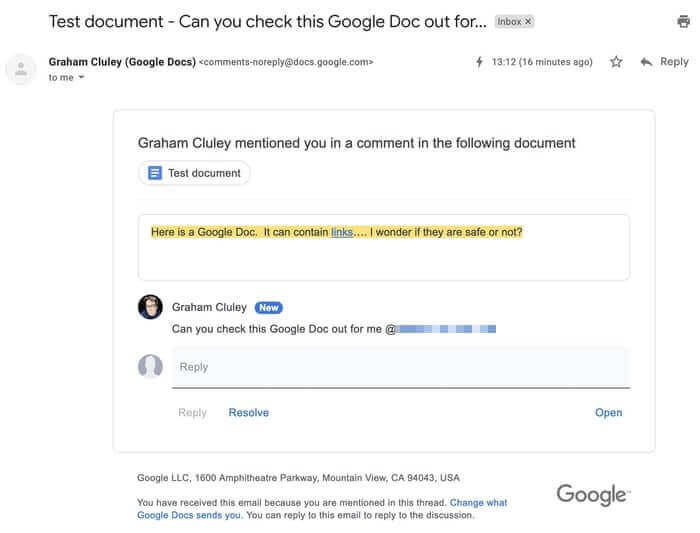
All a fraudster needs to do is create a Google document, spreadsheet, or presentation, and add comments that tag the intended target’s email address. Google sees that as an invitation to “helpfully” inform the user that they have been tagged and send them the document’s content (including any malicious links.)

Use of the technique to spread malicious spam and phishing messages not only makes it more difficult for individuals to determine if an email is dangerous or not, but may also present additional challenges for email-filtering solutions that treat Google as a trusted sender.

Avanan researcher Jeremy Fuchs writes that the latest attack he has seen targeted Outlook users – although not exclusively:

“It hit over 500 inboxes across 30 tenants, with hackers using over 100 different Gmail accounts.”

The problem is compounded by the emails not containing the attacker’s email address, but just their display name.

In other words, a malicious attacker could create a free Google account of “[email protected]”, for instance, and use it to pose as “[email protected]”. If the intended target also worked at “company.com” then they might easily be fooled into thinking it was a genuine notification about a comment left in a Google Doc by one of their colleagues.

The technique could be used to spread links pointing to malware, as well as phishing links that may attempt to steal login credentials from unwary users.

Fuchs claims that Google has not responded to the issue, despite the threat of how Google Docs comments could be exploited to spread spam being publicised in the tech press last October.

Concerned users can protect themselves by being cautious about clicking on suspicious links, and – if still unsure – reach out to the legitimate sender to see if they genuinely tagged them in a Google Doc or other collaboration app.


Editor’s Note: The opinions expressed in this guest author article are solely those of the contributor, and do not necessarily reflect those of Tripwire, Inc.

The post ” Attack Misuses Google Docs Comments to Spew Out “Massive Wave” of Malicious Links” appeared first on TripWire

Source:TripWire – Graham Cluley

Tags: Encryption, Exploit, Google, Phishing, TripWire

Continue Reading

Previous Log4Shell-like Critical RCE Flaw Discovered in H2 Database Console
Next Log4J-Related RCE Flaw in H2 Database Earns Critical Rating

More Stories

  • Critical Vulnerability
  • Cyber Attacks
  • Data Breach
  • Malware
  • Vulnerabilities

China-Linked DKnife AitM Framework Targets Routers for Traffic Hijacking, Malware Delivery

13 hours ago [email protected] (The Hacker News)
  • Cyber Attacks
  • Data Breach
  • Vulnerabilities

CISA Orders Removal of Unsupported Edge Devices to Reduce Federal Network Risk

14 hours ago [email protected] (The Hacker News)
  • Critical Vulnerability
  • Cyber Attacks
  • Data Breach
  • Malware
  • Vulnerabilities

Asian State-Backed Group TGR-STA-1030 Breaches 70 Government, Infrastructure Entities

15 hours ago [email protected] (The Hacker News)
  • Cyber Attacks
  • Data Breach

How Samsung Knox Helps Stop Your Network Security Breach

17 hours ago [email protected] (The Hacker News)
  • Cyber Attacks
  • Data Breach
  • Malware
  • Vulnerabilities

Compromised dYdX npm and PyPI Packages Deliver Wallet Stealers and RAT Malware

19 hours ago [email protected] (The Hacker News)
  • Critical Vulnerability
  • Data Breach
  • Vulnerabilities

Claude Opus 4.6 Finds 500+ High-Severity Flaws Across Major Open-Source Libraries

22 hours ago [email protected] (The Hacker News)

Recent Posts

  • China-Linked DKnife AitM Framework Targets Routers for Traffic Hijacking, Malware Delivery
  • CISA Orders Removal of Unsupported Edge Devices to Reduce Federal Network Risk
  • Asian State-Backed Group TGR-STA-1030 Breaches 70 Government, Infrastructure Entities
  • How Samsung Knox Helps Stop Your Network Security Breach
  • Compromised dYdX npm and PyPI Packages Deliver Wallet Stealers and RAT Malware

Tags

Android APT Bug CERT Cloud Compliance Coronavirus COVID-19 Critical Severity Encryption Exploit Facebook Finance Google Google Chrome Goverment Hacker Hacker News High Severity Instagram iPhone Java Linux Low Severity Malware Medium Severity Microsoft Moderate Severity Mozzila Firefox Oracle Patch Tuesday Phishing Privacy QuickHeal Ransomware RAT Sim The Hacker News Threatpost TikTok TripWire VMWARE Vulnerability Whatsapp Zoom
Copyright © 2020 All rights reserved | NGTEdu.com
This website uses cookies to improve your experience. We'll assume you're ok with this, but you can opt-out if you wish. Read More here.Cookie settingsACCEPT
Privacy & Cookies Policy

Privacy Overview

This website uses cookies to improve your experience while you navigate through the website. Out of these cookies, the cookies that are categorized as necessary are stored on your browser as they are essential for the working of basic functionalities of the website. We also use third-party cookies that help us analyze and understand how you use this website. These cookies will be stored in your browser only with your consent. You also have the option to opt-out of these cookies. But opting out of some of these cookies may have an effect on your browsing experience.
Necessary
Always Enabled
Necessary cookies are absolutely essential for the website to function properly. This category only includes cookies that ensures basic functionalities and security features of the website. These cookies do not store any personal information.
Non-necessary
Any cookies that may not be particularly necessary for the website to function and is used specifically to collect user personal data via analytics, ads, other embedded contents are termed as non-necessary cookies. It is mandatory to procure user consent prior to running these cookies on your website.
SAVE & ACCEPT