
Skip to content
NGTEdu Logo

NGTEdu

A PRODUCT OF NGTECH.CO.IN

NGTEdu Logo

NGTEdu

  • Home
  • Cyber Attacks
  • Malware
  • Vulnerabilities
  • Data Breach
  • Home
  • Data Breach
  • As tax deadlines approach, Emotet malware disguises itself in an IRS email
  • Data Breach
  • Malware

As tax deadlines approach, Emotet malware disguises itself in an IRS email

4 years ago Graham Cluley
As tax deadlines approach, Emotet malware disguises itself in an IRS email

With just a few weeks until the April 15 deadline for US individuals and businesses to file their tax returns, scammers are as busy as ever.

Security researchers at Cofsense have warned that they have seen a number of malicious email campaigns which pose as communications from the Internal Revenue Service (IRS).

The emails which purport to come from “IRS.gov”, claim to contain tax forms (such as a W-9) that need to be filled out by the recipient.

However, in truth the bogus emails are an attempt to infect the PCs of unsuspecting computer users with the notorious Emotet malware.

Emotet is an extremely advanced family of malware, which is capable of dropping other malware onto users’ computers.

First rearing its ugly head in 2014 as a banking Trojan horse, Emotet has evolved over the years, sometimes updating itself multiple times a day, as it becomes more sophisticated in its attempt to bypass defences and hit as many victims as possible.

In the latest campaigns, potential victims are duped into opening email attachments and then enabling macros in Office documents which will download and install further malware, and attempt to spread across your company network.

On many occasions Emotet has been deployed by cybercriminals as part of an attempt to ultimately hit an organisation with ransomware, and demand a large ransom.

In an attempt to avoid detection by email-scanning defences, the attachments in some of the latest IRS-related campaigns have been packaged in a password-protected .ZIP archive.
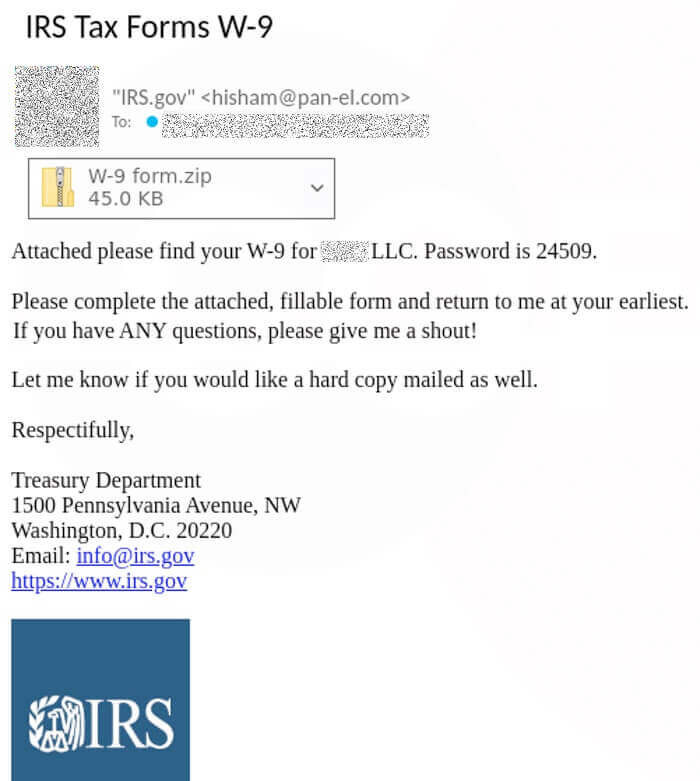
Your email gateway-scanning solution may not know the password that has been used to compress the attachment, but it is contained in the message body – which is enough for a reckless user to decompress the archive file and open its contents.

Bleeping Computer reports that the .ZIP files contain an Excel spreadsheet called “W-9 form.xlsm” which, when opened, prompts the user to enable macros.

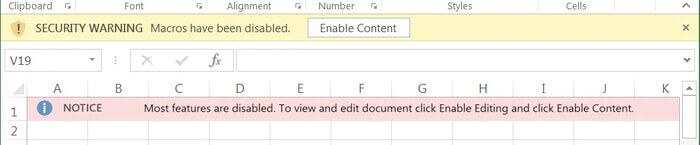
enable-content

Unfortunately, following the boobytrapped spreadsheet’s instructions leads to malicious code being activated.

In the past the IRS has made clear that it never sends out emails about tax refunds or sensitive financial information.

The IRS has published advice on what you should do if you receive a suspicious IRS-related message.


Editor’s Note: The opinions expressed in this guest author article are solely those of the contributor, and do not necessarily reflect those of Tripwire, Inc.

The post ” As tax deadlines approach, Emotet malware disguises itself in an IRS email” appeared first on TripWire

Source:TripWire – Graham Cluley

Tags: Encryption, Goverment, Malware, Phishing, Privacy, Ransomware, TripWire

Continue Reading

Previous Misconfigured Firebase Databases Exposing Data in Mobile Apps
Next Dev Sabotages Popular NPM Package to Protest Russian Invasion

More Stories

  • Critical Vulnerability
  • Cyber Attacks
  • Data Breach
  • Malware
  • Vulnerabilities

China-Linked DKnife AitM Framework Targets Routers for Traffic Hijacking, Malware Delivery

16 hours ago [email protected] (The Hacker News)
  • Cyber Attacks
  • Data Breach
  • Vulnerabilities

CISA Orders Removal of Unsupported Edge Devices to Reduce Federal Network Risk

18 hours ago [email protected] (The Hacker News)
  • Critical Vulnerability
  • Cyber Attacks
  • Data Breach
  • Malware
  • Vulnerabilities

Asian State-Backed Group TGR-STA-1030 Breaches 70 Government, Infrastructure Entities

19 hours ago [email protected] (The Hacker News)
  • Cyber Attacks
  • Data Breach

How Samsung Knox Helps Stop Your Network Security Breach

21 hours ago [email protected] (The Hacker News)
  • Cyber Attacks
  • Data Breach
  • Malware
  • Vulnerabilities

Compromised dYdX npm and PyPI Packages Deliver Wallet Stealers and RAT Malware

23 hours ago [email protected] (The Hacker News)
  • Critical Vulnerability
  • Data Breach
  • Vulnerabilities

Claude Opus 4.6 Finds 500+ High-Severity Flaws Across Major Open-Source Libraries

1 day ago [email protected] (The Hacker News)

Recent Posts

  • China-Linked DKnife AitM Framework Targets Routers for Traffic Hijacking, Malware Delivery
  • CISA Orders Removal of Unsupported Edge Devices to Reduce Federal Network Risk
  • Asian State-Backed Group TGR-STA-1030 Breaches 70 Government, Infrastructure Entities
  • How Samsung Knox Helps Stop Your Network Security Breach
  • Compromised dYdX npm and PyPI Packages Deliver Wallet Stealers and RAT Malware

Tags

Android APT Bug CERT Cloud Compliance Coronavirus COVID-19 Critical Severity Encryption Exploit Facebook Finance Google Google Chrome Goverment Hacker Hacker News High Severity Instagram iPhone Java Linux Low Severity Malware Medium Severity Microsoft Moderate Severity Mozzila Firefox Oracle Patch Tuesday Phishing Privacy QuickHeal Ransomware RAT Sim The Hacker News Threatpost TikTok TripWire VMWARE Vulnerability Whatsapp Zoom
Copyright © 2020 All rights reserved | NGTEdu.com
This website uses cookies to improve your experience. We'll assume you're ok with this, but you can opt-out if you wish. Read More here.Cookie settingsACCEPT
Privacy & Cookies Policy

Privacy Overview

This website uses cookies to improve your experience while you navigate through the website. Out of these cookies, the cookies that are categorized as necessary are stored on your browser as they are essential for the working of basic functionalities of the website. We also use third-party cookies that help us analyze and understand how you use this website. These cookies will be stored in your browser only with your consent. You also have the option to opt-out of these cookies. But opting out of some of these cookies may have an effect on your browsing experience.
Necessary
Always Enabled
Necessary cookies are absolutely essential for the website to function properly. This category only includes cookies that ensures basic functionalities and security features of the website. These cookies do not store any personal information.
Non-necessary
Any cookies that may not be particularly necessary for the website to function and is used specifically to collect user personal data via analytics, ads, other embedded contents are termed as non-necessary cookies. It is mandatory to procure user consent prior to running these cookies on your website.
SAVE & ACCEPT