
Skip to content
NGTEdu Logo

NGTEdu

A PRODUCT OF NGTECH.CO.IN

NGTEdu Logo

NGTEdu

  • Home
  • Cyber Attacks
  • Malware
  • Vulnerabilities
  • Data Breach
  • Home
  • Cyber Attacks
  • Amazon Web Services Mitigated a 2.3 Tbps DDoS Attack
  • Cyber Attacks
  • Data Breach

Amazon Web Services Mitigated a 2.3 Tbps DDoS Attack

6 years ago David Bisson
Amazon Web Services Mitigated a 2.3 Tbps DDoS Attack

Amazon Web Services (AWS) said that it mitigated a distributed denial-of-service (DDoS) attack with a volume of 2.3 Tbps.

In its “Threat Landscape Report – Q1 2020,” AWS Shield revealed that its team members had spent several days responding to this particular network volumetric DDoS attack.

In Q1 2020, a known UDP reflection vector, CLDAP reflection, was observed with a previously unseen volume of 2.3 Tbps. This is approximately 44% larger than any network volumetric event previously detected on AWS. CLDAP reflection attacks of this magnitude caused 3 days of elevated threat during a single week in February 2020 before subsiding.

The AWS report did not disclose the identity of the customer that suffered this attack.

Short for “Connection-less Lightweight Directory Access Protocol,” CLDAP serves an alternative to Microsoft’s Lightweight Directory Access Protocol (LDAP).

Akamai first observed malicious actors abuse CLDAP for conducting amplified DDoS reflection attacks back in October 2016. Those attacks began when a nefarious individual sent a CLDAP request to a LDAP server with a spoofed IP address. The server then added its own data to the response and sent it to the spoofed IP address, or the victim’s IP address. This action subsequently produced a DDoS attack, as machines can’t process too much CLDAP data at once.
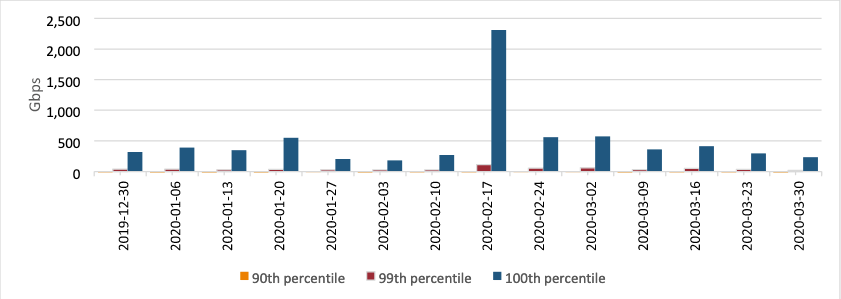
P90, P99, and P100 of volumetric events, measured in gigabits per second (Gbps), for resources on AWS during Q1 2020. (Source: AWS)

Prior to the attack discussed above, NETSCOUT Arbor observed a 1.7 Tbps reflection/amplification DDoS attack against a U.S. service provider in March 2018. News of that attack came just a month after GitHub announced that it had mitigated a volumetric DDoS attack that had peaked at 1.35 Tbps.

These attacks highlight the need for organizations to defend themselves against DDoS attacks. They can begin by creating a distributed denial-of-service mitigation plan and by building it into their incident response plan. For additional tips, click here.

The post ” Amazon Web Services Mitigated a 2.3 Tbps DDoS Attack” appeared first on TripWire

Source:TripWire – David Bisson

Tags: Encryption, Microsoft, TripWire

Continue Reading

Previous InvisiMole Group Resurfaces Touting Fresh Toolset, Gamaredon Partnership
Next Copied master key forces South African bank to replace 12 million cards

More Stories

  • Cyber Attacks
  • Data Breach
  • Malware
  • Vulnerabilities

Iran-Linked RedKitten Cyber Campaign Targets Human Rights NGOs and Activists

1 day ago [email protected] (The Hacker News)
  • Cyber Attacks
  • Data Breach
  • Malware
  • Vulnerabilities

Mandiant Finds ShinyHunters-Style Vishing Attacks Stealing MFA to Breach SaaS Platforms

2 days ago [email protected] (The Hacker News)
  • Cyber Attacks
  • Data Breach
  • Malware

CERT Polska Details Coordinated Cyber Attacks on 30+ Wind and Solar Farms

2 days ago [email protected] (The Hacker News)
  • Cyber Attacks
  • Data Breach
  • Malware
  • Vulnerabilities

Researchers Uncover Chrome Extensions Abusing Affiliate Links and Stealing ChatGPT Access

2 days ago [email protected] (The Hacker News)
  • Cyber Attacks
  • Data Breach
  • Malware
  • Vulnerabilities

China-Linked UAT-8099 Targets IIS Servers in Asia with BadIIS SEO Malware

2 days ago [email protected] (The Hacker News)
  • Cyber Attacks
  • Data Breach
  • Malware

Ex-Google Engineer Convicted for Stealing 2,000 AI Trade Secrets for China Startup

3 days ago [email protected] (The Hacker News)

Recent Posts

  • Iran-Linked RedKitten Cyber Campaign Targets Human Rights NGOs and Activists
  • Mandiant Finds ShinyHunters-Style Vishing Attacks Stealing MFA to Breach SaaS Platforms
  • CERT Polska Details Coordinated Cyber Attacks on 30+ Wind and Solar Farms
  • Researchers Uncover Chrome Extensions Abusing Affiliate Links and Stealing ChatGPT Access
  • China-Linked UAT-8099 Targets IIS Servers in Asia with BadIIS SEO Malware

Tags

Android APT Bug CERT Cloud Compliance Coronavirus COVID-19 Critical Severity Encryption Exploit Facebook Finance Google Google Chrome Goverment Hacker Hacker News High Severity Instagram iPhone Java Linux Low Severity Malware Medium Severity Microsoft Moderate Severity Mozzila Firefox Oracle Patch Tuesday Phishing Privacy QuickHeal Ransomware RAT Sim The Hacker News Threatpost TikTok TripWire VMWARE Vulnerability Whatsapp Zoom
Copyright © 2020 All rights reserved | NGTEdu.com
This website uses cookies to improve your experience. We'll assume you're ok with this, but you can opt-out if you wish. Read More here.Cookie settingsACCEPT
Privacy & Cookies Policy

Privacy Overview

This website uses cookies to improve your experience while you navigate through the website. Out of these cookies, the cookies that are categorized as necessary are stored on your browser as they are essential for the working of basic functionalities of the website. We also use third-party cookies that help us analyze and understand how you use this website. These cookies will be stored in your browser only with your consent. You also have the option to opt-out of these cookies. But opting out of some of these cookies may have an effect on your browsing experience.
Necessary
Always Enabled
Necessary cookies are absolutely essential for the website to function properly. This category only includes cookies that ensures basic functionalities and security features of the website. These cookies do not store any personal information.
Non-necessary
Any cookies that may not be particularly necessary for the website to function and is used specifically to collect user personal data via analytics, ads, other embedded contents are termed as non-necessary cookies. It is mandatory to procure user consent prior to running these cookies on your website.
SAVE & ACCEPT