
Skip to content
NGTEdu Logo

NGTEdu

A PRODUCT OF NGTECH.CO.IN

NGTEdu Logo

NGTEdu

  • Home
  • Cyber Attacks
  • Malware
  • Vulnerabilities
  • Data Breach
  • Home
  • Cyber Attacks
  • FluBot malware warning after 70,000 attacks launched over SMS
  • Cyber Attacks
  • Data Breach
  • Malware

FluBot malware warning after 70,000 attacks launched over SMS

4 years ago Graham Cluley
FluBot malware warning after 70,000 attacks launched over SMS

Finland’s National Cyber Security Centre (NCSC-FI) has issued a warning about malicious SMS messages that have been spammed out to mobile users, directing iPhone owners to phishing sites and Android users to download malware.

The messages are written in Finnish but without the customary accented characters. In some instances, the messages pose as a notification that the user has received a voicemail message, or a communication from their mobile network provider.

Fortunately, clicking on the link contained within the message does not automatically initiate an automatic download for recipients using Android devices, but instead requires user confirmation that they wish to install a program.
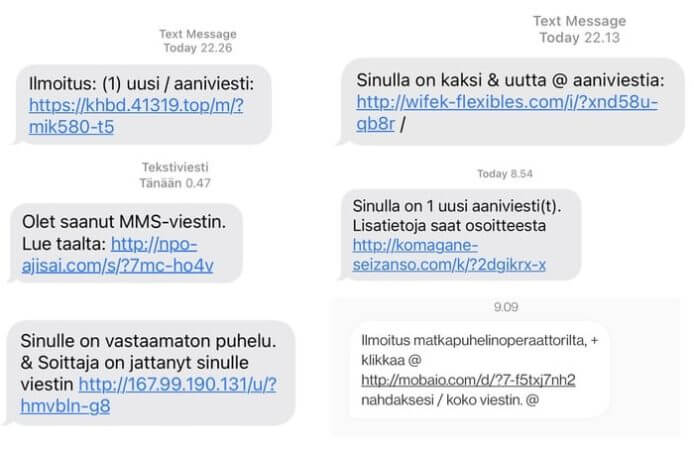
According to an alert issued by NCSC-FI, which saw approximately 70,000 SMS messages sent by hackers in just 24 hours, victims have found their Android devices infected with the FluBot malware.

Of course, non-Finnish speakers will likely be instantly suspicious if they receive a message written in a language they understand. But there is nothing to stop hackers from altering the campaign to target users of other languages.

In the past cybercriminals have distributed FluBot via bogus messages that claim to help intended victims track parcel deliveries or listen to a voicemail message, or via web pages that claim a user’s Android device has been infected with malware, and that they should urgently install a security update.

FluBot Update

Of course, following the instructions and installing the security update actually infects devices.

Once in place, FluBot is capable of stealing banking credentials, payment details, text messages, and contact information from victims’ devices.

Users who have already infected their devices with FluBot are advised by NCSC-FI to perform a factory reset and restore from a backup that was created before the malware infection took place.

Last week Netcraft reported that criminals have compromised legitimate websites running vulnerable WordPress plugins and themes to upload their malicious content.


Editor’s Note: The opinions expressed in this guest author article are solely those of the contributor, and do not necessarily reflect those of Tripwire, Inc.

The post ” FluBot malware warning after 70,000 attacks launched over SMS” appeared first on TripWire

Source:TripWire – Graham Cluley

Tags: Android, Encryption, iPhone, Phishing, TripWire

Continue Reading

Previous Meta Expands Facebook Protect Program to Activists, Journalists, Government Officials
Next AT&T Takes Steps to Mitigate Botnet Found Inside Its Network 

More Stories

  • Cyber Attacks

⚡ Weekly Recap: Telecom Sleeper Cells, LLM Jailbreaks, Apple Forces U.K. Age Checks and More

2 hours ago [email protected] (The Hacker News)
  • Malware

Three China-Linked Clusters Target Southeast Asian Government in 2025 Cyber Campaign

9 hours ago [email protected] (The Hacker News)
  • Cyber Attacks
  • Data Breach

Iran-Linked Hackers Breach FBI Director’s Personal Email, Hit Stryker With Wiper Attack

2 days ago [email protected] (The Hacker News)
  • Critical Vulnerability
  • Cyber Attacks
  • Vulnerabilities

CISA Adds CVE-2025-53521 to KEV After Active F5 BIG-IP APM Exploitation

2 days ago [email protected] (The Hacker News)
  • Critical Vulnerability
  • Cyber Attacks

Apple Sends Lock Screen Alerts to Outdated iPhones Over Active Web-Based Exploits

3 days ago [email protected] (The Hacker News)
  • Cyber Attacks
  • Data Breach

TeamPCP Pushes Malicious Telnyx Versions to PyPI, Hides Stealer in WAV Files

3 days ago [email protected] (The Hacker News)

Recent Posts

  • ⚡ Weekly Recap: Telecom Sleeper Cells, LLM Jailbreaks, Apple Forces U.K. Age Checks and More
  • 3 SOC Process Fixes That Unlock Tier 1 Productivity
  • The State of Secrets Sprawl 2026: 9 Takeaways for CISOs
  • Russian CTRL Toolkit Delivered via Malicious LNK Files Hijacks RDP via FRP Tunnels
  • Three China-Linked Clusters Target Southeast Asian Government in 2025 Cyber Campaign

Tags

Android APT Bug CERT Cloud Compliance Coronavirus COVID-19 Critical Severity Encryption Exploit Facebook Finance Google Google Chrome Goverment Hacker Hacker News High Severity Instagram iPhone Java Linux Low Severity Malware Medium Severity Microsoft Moderate Severity Mozzila Firefox Oracle Patch Tuesday Phishing Privacy QuickHeal Ransomware RAT Sim The Hacker News Threatpost TikTok TripWire VMWARE Vulnerability Whatsapp Zoom
Copyright © 2020 All rights reserved | NGTEdu.com
This website uses cookies to improve your experience. We'll assume you're ok with this, but you can opt-out if you wish. Read More here.Cookie settingsACCEPT
Privacy & Cookies Policy

Privacy Overview

This website uses cookies to improve your experience while you navigate through the website. Out of these cookies, the cookies that are categorized as necessary are stored on your browser as they are essential for the working of basic functionalities of the website. We also use third-party cookies that help us analyze and understand how you use this website. These cookies will be stored in your browser only with your consent. You also have the option to opt-out of these cookies. But opting out of some of these cookies may have an effect on your browsing experience.
Necessary
Always Enabled
Necessary cookies are absolutely essential for the website to function properly. This category only includes cookies that ensures basic functionalities and security features of the website. These cookies do not store any personal information.
Non-necessary
Any cookies that may not be particularly necessary for the website to function and is used specifically to collect user personal data via analytics, ads, other embedded contents are termed as non-necessary cookies. It is mandatory to procure user consent prior to running these cookies on your website.
SAVE & ACCEPT