
Skip to content
NGTEdu Logo

NGTEdu

A PRODUCT OF NGTECH.CO.IN

NGTEdu Logo

NGTEdu

  • Home
  • Cyber Attacks
  • Malware
  • Vulnerabilities
  • Data Breach
  • Home
  • Data Breach
  • Zoom Releases New Security Features to Counter Zoombombing
  • Data Breach

Zoom Releases New Security Features to Counter Zoombombing

5 years ago David Bisson
Zoom Releases New Security Features to Counter Zoombombing

Zoom released new security features to help its users counter disruptive meeting intrusions, otherwise known as “Zoombombing.”

Matt Nagel, security & privacy PR lead at the American communications technology company, announced in a blog post on November 16 that Zoom had released two new anti-Zoombombing features over the previous weekend.

The first new feature enables hosts and co-hosts to temporarily pause all meeting activity including recording, chat, screen sharing and breakout rooms.

Nagel explained how hosts and co-hosts can use this feature to eject disruptive participants from their meeting:

The hosts or co-host will be asked if they would like to report a user from their meeting, share any details, and optionally include a screenshot. Once they click “Submit,” the reported user will be removed from their meeting, and Zoom’s Trust & Safety team will be notified. Hosts and co-hosts may resume their meeting by individually re-enabling the features they’d like to use. Zoom will also send them an email after the meeting to gather more information.

This feature is enabled by default for all Zoom users.

The second new capability announced by Zoom allows meeting participants to report disruptive users directly from the video app client.

All hosts and co-hosts need to do is make sure that this reporting feature is enabled for participants in their web settings.
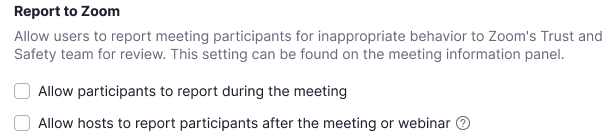
A screenshot of the “Report to Zoom” web settings. (Source: Zoom)

News of these two new features arrived soon after Zoom announced that it would be deploying an “At-Risk Meeting Notifier” to scan public social media posts and other websites for shared Zoom meeting links, automatically alert account holders if and when it found something as well as help them take action to prevent Zoombombing.

Zoom clarified that one of the best ways for users to protect themselves against Zoombombing is to never share their meeting ID or passcode on a public site.

Users can follow these best practices to strengthen their Zoom security even further.

The post ” Zoom Releases New Security Features to Counter Zoombombing” appeared first on TripWire

Source:TripWire – David Bisson

Tags: Encryption, Privacy, TripWire, Zoom

Continue Reading

Previous Chinese APT Hackers Target Southeast Asian Government Institutions
Next Some Apple Apps on macOS Big Sur Bypass Content Filters, VPNs

More Stories

  • Cyber Attacks
  • Data Breach

Microsoft Develops Scanner to Detect Backdoors in Open-Weight Large Language Models

3 hours ago [email protected] (The Hacker News)
  • Cyber Attacks
  • Data Breach
  • Malware
  • Vulnerabilities

DEAD#VAX Malware Campaign Deploys AsyncRAT via IPFS-Hosted VHD Phishing Files

3 hours ago [email protected] (The Hacker News)
  • Cyber Attacks
  • Data Breach
  • Malware
  • Vulnerabilities

China-Linked Amaranth-Dragon Exploits WinRAR Flaw in Espionage Campaigns

7 hours ago [email protected] (The Hacker News)
  • Data Breach

Orchid Security Introduces Continuous Identity Observability for Enterprise Applications

9 hours ago [email protected] (The Hacker News)
  • Critical Vulnerability
  • Cyber Attacks
  • Data Breach
  • Malware
  • Vulnerabilities

The First 90 Seconds: How Early Decisions Shape Incident Response Investigations

11 hours ago [email protected] (The Hacker News)
  • Cyber Attacks
  • Data Breach
  • Malware
  • Vulnerabilities

Microsoft Warns Python Infostealers Target macOS via Fake Ads and Installers

13 hours ago [email protected] (The Hacker News)

Recent Posts

  • Microsoft Develops Scanner to Detect Backdoors in Open-Weight Large Language Models
  • DEAD#VAX Malware Campaign Deploys AsyncRAT via IPFS-Hosted VHD Phishing Files
  • China-Linked Amaranth-Dragon Exploits WinRAR Flaw in Espionage Campaigns
  • Orchid Security Introduces Continuous Identity Observability for Enterprise Applications
  • The First 90 Seconds: How Early Decisions Shape Incident Response Investigations

Tags

Android APT Bug CERT Cloud Compliance Coronavirus COVID-19 Critical Severity Encryption Exploit Facebook Finance Google Google Chrome Goverment Hacker Hacker News High Severity Instagram iPhone Java Linux Low Severity Malware Medium Severity Microsoft Moderate Severity Mozzila Firefox Oracle Patch Tuesday Phishing Privacy QuickHeal Ransomware RAT Sim The Hacker News Threatpost TikTok TripWire VMWARE Vulnerability Whatsapp Zoom
Copyright © 2020 All rights reserved | NGTEdu.com
This website uses cookies to improve your experience. We'll assume you're ok with this, but you can opt-out if you wish. Read More here.Cookie settingsACCEPT
Privacy & Cookies Policy

Privacy Overview

This website uses cookies to improve your experience while you navigate through the website. Out of these cookies, the cookies that are categorized as necessary are stored on your browser as they are essential for the working of basic functionalities of the website. We also use third-party cookies that help us analyze and understand how you use this website. These cookies will be stored in your browser only with your consent. You also have the option to opt-out of these cookies. But opting out of some of these cookies may have an effect on your browsing experience.
Necessary
Always Enabled
Necessary cookies are absolutely essential for the website to function properly. This category only includes cookies that ensures basic functionalities and security features of the website. These cookies do not store any personal information.
Non-necessary
Any cookies that may not be particularly necessary for the website to function and is used specifically to collect user personal data via analytics, ads, other embedded contents are termed as non-necessary cookies. It is mandatory to procure user consent prior to running these cookies on your website.
SAVE & ACCEPT