
Skip to content
NGTEdu Logo

NGTEdu

A PRODUCT OF NGTECH.CO.IN

NGTEdu Logo

NGTEdu

  • Home
  • Cyber Attacks
  • Malware
  • Vulnerabilities
  • Data Breach
  • Home
  • Cyber Attacks
  • New Smishing Campaign Using USPS as Its Disguise
  • Cyber Attacks
  • Data Breach
  • Malware

New Smishing Campaign Using USPS as Its Disguise

5 years ago David Bisson
New Smishing Campaign Using USPS as Its Disguise

A new SMS-based phishing (“smishing”) campaign is using the United States Postal Service (USPS) as a disguise to target mobile users.

On September 15, SlickRockWeb CEO Eric JN Eliason tweeted out two examples of the operation.

Both attack SMS messages claimed to contain important information about a USPS package. Using that lure, they attempted to trick the recipient into clicking on a link containing the domain “m9sxv[.]info.”
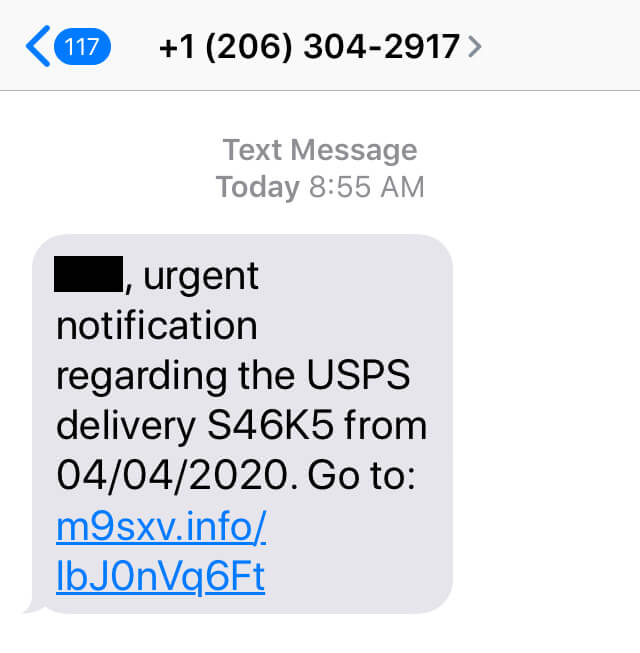
An example of the smishing campaign masquerading as the USPS. (Source: Twitter)

Eliason decided to do some digging into the domain. He found that whoever was responsible for having registered it had done so on September 15. In the process, he also uncovered several individual smishing links using that domain.

SlickRockWeb’s CEO looked a bit deeper to see what happened if a recipient clicked on any of those smishing links. He observed that the links exhibited varying behaviors. In one instance, the link redirected the user to jtuzd.rdtk[.]io. Another led them to a fake casino game, while most others appeared to try to steal victims’ credentials for their Google accounts.

This smishing campaign isn’t the first time that a delivery scam gained people’s attention in 2020. Back in February, for instance, the U.S. Federal Trade Commission issued an alert warning users to be on the lookout for SMS messages that appeared to originate from FedEx.

It was just a few months later when the Better Business Bureau published some guidelines on how individual users could avoid falling victim to a SMS-based delivery scam. Those recommendations included verifying the tracking information of an expected delivery and examining a link before clicking on it.

Smishing is just one of the ways that malicious actors seek to steal users’ credentials and/or infect their machines with malware. Acknowledging that fact, organizations should consider using ongoing security awareness training to educate their employees about some of the most common phishing attacks that are in circulation today.

The post ” New Smishing Campaign Using USPS as Its Disguise” appeared first on TripWire

Source:TripWire – David Bisson

Tags: Encryption, Google, Goverment, Phishing, TripWire

Continue Reading

Previous 2 Hackers Charged for Defacing Sites after U.S. Airstrike Killed Iranian General
Next Bluetooth Spoofing Bug Affects Billions of IoT Devices

More Stories

  • Cyber Attacks
  • Data Breach

Mozilla Adds One-Click Option to Disable Generative AI Features in Firefox

2 hours ago [email protected] (The Hacker News)
  • Cyber Attacks
  • Data Breach
  • Malware
  • Vulnerabilities

Notepad++ Hosting Breach Attributed to China-Linked Lotus Blossom Hacking Group

3 hours ago [email protected] (The Hacker News)
  • Cyber Attacks
  • Data Breach
  • Malware
  • Vulnerabilities

Researchers Find 341 Malicious ClawHub Skills Stealing Data from OpenClaw Users

14 hours ago [email protected] (The Hacker News)
  • Cyber Attacks
  • Data Breach
  • Vulnerabilities

OpenClaw Bug Enables One-Click Remote Code Execution via Malicious Link

16 hours ago [email protected] (The Hacker News)
  • Cyber Attacks
  • Data Breach

Microsoft Begins NTLM Phase-Out With Three-Stage Plan to Move Windows to Kerberos

16 hours ago [email protected] (The Hacker News)
  • Critical Vulnerability
  • Cyber Attacks
  • Data Breach
  • Malware
  • Vulnerabilities

⚡ Weekly Recap: Proxy Botnet, Office Zero-Day, MongoDB Ransoms, AI Hijacks & New Threats

20 hours ago [email protected] (The Hacker News)

Recent Posts

  • Mozilla Adds One-Click Option to Disable Generative AI Features in Firefox
  • Notepad++ Hosting Breach Attributed to China-Linked Lotus Blossom Hacking Group
  • Researchers Find 341 Malicious ClawHub Skills Stealing Data from OpenClaw Users
  • OpenClaw Bug Enables One-Click Remote Code Execution via Malicious Link
  • Microsoft Begins NTLM Phase-Out With Three-Stage Plan to Move Windows to Kerberos

Tags

Android APT Bug CERT Cloud Compliance Coronavirus COVID-19 Critical Severity Encryption Exploit Facebook Finance Google Google Chrome Goverment Hacker Hacker News High Severity Instagram iPhone Java Linux Low Severity Malware Medium Severity Microsoft Moderate Severity Mozzila Firefox Oracle Patch Tuesday Phishing Privacy QuickHeal Ransomware RAT Sim The Hacker News Threatpost TikTok TripWire VMWARE Vulnerability Whatsapp Zoom
Copyright © 2020 All rights reserved | NGTEdu.com
This website uses cookies to improve your experience. We'll assume you're ok with this, but you can opt-out if you wish. Read More here.Cookie settingsACCEPT
Privacy & Cookies Policy

Privacy Overview

This website uses cookies to improve your experience while you navigate through the website. Out of these cookies, the cookies that are categorized as necessary are stored on your browser as they are essential for the working of basic functionalities of the website. We also use third-party cookies that help us analyze and understand how you use this website. These cookies will be stored in your browser only with your consent. You also have the option to opt-out of these cookies. But opting out of some of these cookies may have an effect on your browsing experience.
Necessary
Always Enabled
Necessary cookies are absolutely essential for the website to function properly. This category only includes cookies that ensures basic functionalities and security features of the website. These cookies do not store any personal information.
Non-necessary
Any cookies that may not be particularly necessary for the website to function and is used specifically to collect user personal data via analytics, ads, other embedded contents are termed as non-necessary cookies. It is mandatory to procure user consent prior to running these cookies on your website.
SAVE & ACCEPT