
Skip to content
NGTEdu Logo

NGTEdu

A PRODUCT OF NGTECH.CO.IN

NGTEdu Logo

NGTEdu

  • Home
  • Cyber Attacks
  • Malware
  • Vulnerabilities
  • Data Breach
  • Home
  • Cyber Attacks
  • Identifying the Most Dangerous Common Software and Hardware Weaknesses and Vulnerabilities – The CWE Top 25 (2020 Edition)

  • Cyber Attacks
  • Data Breach
  • Vulnerabilities

Identifying the Most Dangerous Common Software and Hardware Weaknesses and Vulnerabilities – The CWE Top 25 (2020 Edition)

6 years ago Matthew Jerzewski
Identifying the Most Dangerous Common Software and Hardware Weaknesses and Vulnerabilities – The CWE Top 25 (2020 Edition)

So far, there has not been a perfect solution to ridding the world of software and hardware weaknesses. Keeping up-to-date with which weaknesses have are most common and impactful can be a daunting task. Thankfully, a list has been made to do just that the Common Weakness Enumeration Top 25 (CWE). The CWE Top 25 is a community-developed list of the most dangerous common software and hardware weaknesses that are often easy to find, exploit, and can allow adversaries to completely take over a system, steal data, or prevent an application from working.

Overview

Below is an overview of the 2020 CWE Top 25 list.
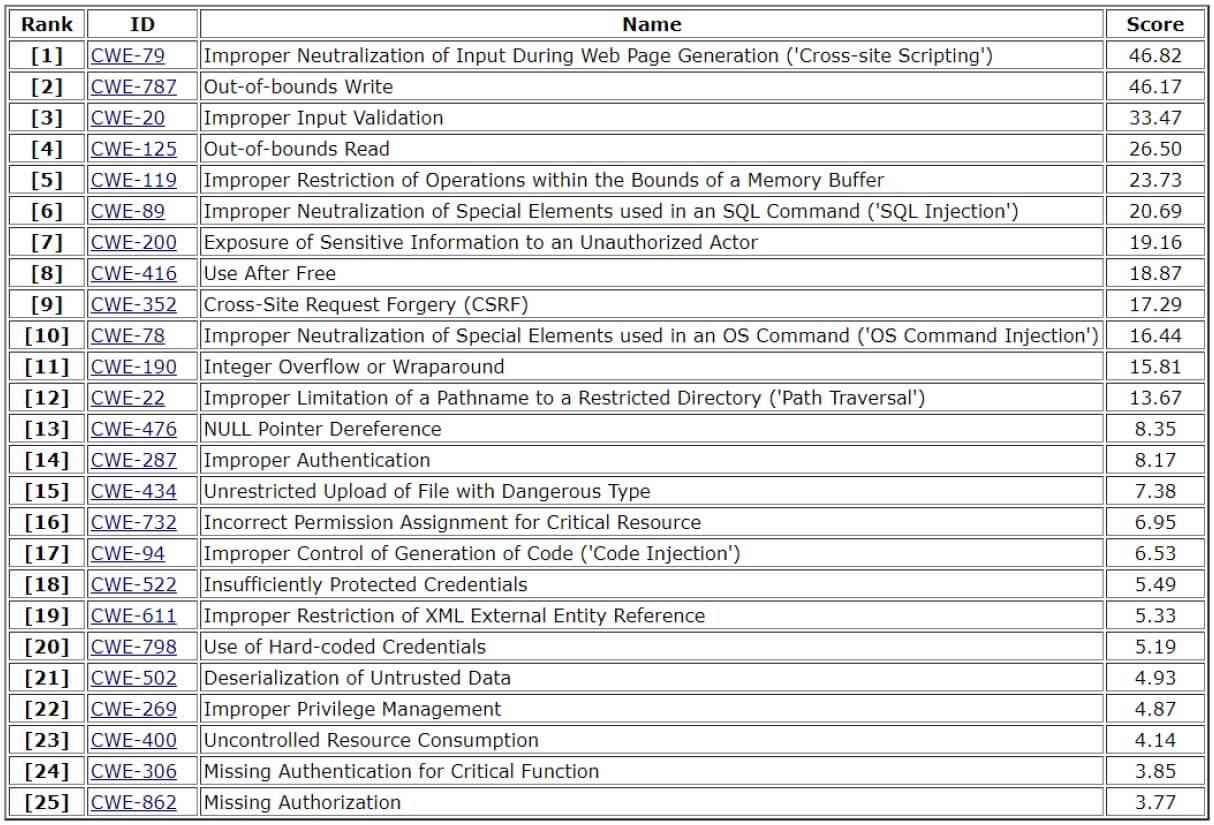
Figure 1 Top 25 CWE 2020

The CWE team created the 2020 list by leveraging the CVE data found within the National Vulnerability Database (NVD) and the CVSS scores associated with each CVE. They created a formula to rank the weaknesses by frequency and impact. First, they generated a normalized count of how many CVEs reference each CWE. Then they normalized the average CVSS score for the vulnerabilities associated with each CWE. The results were multiplied together and then by 100 to create a score out of 100.

Limitations

The CWE Top 25 is not perfect. It is still subjected to several limitations to the data-driven approach.

Data Bias

  • CWE sources data from NVD which doesn’t cover all vulnerabilities. There are numerous vulnerabilities that have not yet been given a CVE ID, and therefore are excluded from the approach. An example would be if a vulnerability was found and fixed before being publicly disclosed.
  • The utilization of CVSS scores from NVD is flawed for several reasons. NVD Analysts have historically had varied views of scoring that has led to different scores for similar vulnerabilities. Additionally, CVSS scores a vulnerability, not the projected severity of exploitation as the CWE Top 25 methodology would have you think. Finally, vendors often release their own information regarding CVSS scoring that, due to their intimate knowledge of the product, is more accurate than the NVD analysts score.
  • Vendor’s who report CVE entries to NVD sometimes lack important details and information on the vulnerability itself, and instead describe just the impact of the vulnerability. This leads to insufficient information in determining the underlying weaknesses.
  • The dataset used by NVD shows inherit bias based on the set of vendors that report vulnerabilities and the programming languages used by those venders. An example would be if one of the larger vendors contributing to NVD used primarily C for their programming language, weaknesses that often exist in C programs would be more likely to appear.

Metric Bias

  • CWE draws attention to an important bias related to the metric and that it, “indirectly prioritizes implementation flaws over design flaws, due to their prevalence within individual software packages.” For example, a web application may have many different code-injection vulnerabilities due to the large attack surface, but only one instance of use of an insecure configuration for input validation.

Conclusion

The CWE Top 25 provides security professionals, developers, and users a more meticulous view of common and impactful weaknesses. The main goal of CWE is, “to stop vulnerabilities at the source by educating software and hardware, architects, designers, programmers, and acquires on how to eliminate the most common mistakes before software and hardware are delivered.” Keeping up-to-date with weaknesses that are seeing a higher frequency and becoming more impactful to hardware and software will help prevent security vulnerabilities and mitigate risk for enterprises and organizations.

The post ” Identifying the Most Dangerous Common Software and Hardware Weaknesses and Vulnerabilities – The CWE Top 25 (2020 Edition)” appeared first on TripWire

Source:TripWire – Matthew Jerzewski

Tags: Encryption, Exploit, Goverment, TripWire, Vulnerability

Continue Reading

Previous Podcast Episode 9 – Cloud Misconfigurations: Simple Mistakes, Big Consequences
Next DoppelPaymer Gang Claims Responsibility for Newcastle University Issues

More Stories

  • Cyber Attacks
  • Data Breach
  • Malware

New Perseus Android Banking Malware Monitors Notes Apps to Extract Sensitive Data

2 hours ago [email protected] (The Hacker News)
  • Data Breach
  • Vulnerabilities

How Ceros Gives Security Teams Visibility and Control in Claude Code

4 hours ago [email protected] (The Hacker News)
  • Cyber Attacks
  • Data Breach
  • Malware
  • Vulnerabilities

DarkSword iOS Exploit Kit Uses 6 Flaws, 3 Zero-Days for Full Device Takeover

6 hours ago [email protected] (The Hacker News)
  • Cyber Attacks
  • Data Breach
  • Malware
  • Vulnerabilities

CISA Warns of Zimbra, SharePoint Flaw Exploits; Cisco Zero-Day Hit in Ransomware Attacks

9 hours ago [email protected] (The Hacker News)
  • Cyber Attacks
  • Data Breach
  • Malware

OFAC Sanctions DPRK IT Worker Network Funding WMD Programs Through Fake Remote Jobs

22 hours ago [email protected] (The Hacker News)
  • Critical Vulnerability
  • Cyber Attacks
  • Data Breach
  • Malware
  • Vulnerabilities

Interlock Ransomware Exploits Cisco FMC Zero-Day CVE-2026-20131 for Root Access

23 hours ago [email protected] (The Hacker News)

Recent Posts

  • New Perseus Android Banking Malware Monitors Notes Apps to Extract Sensitive Data
  • How Ceros Gives Security Teams Visibility and Control in Claude Code
  • DarkSword iOS Exploit Kit Uses 6 Flaws, 3 Zero-Days for Full Device Takeover
  • CISA Warns of Zimbra, SharePoint Flaw Exploits; Cisco Zero-Day Hit in Ransomware Attacks
  • OFAC Sanctions DPRK IT Worker Network Funding WMD Programs Through Fake Remote Jobs

Tags

Android APT Bug CERT Cloud Compliance Coronavirus COVID-19 Critical Severity Encryption Exploit Facebook Finance Google Google Chrome Goverment Hacker Hacker News High Severity Instagram iPhone Java Linux Low Severity Malware Medium Severity Microsoft Moderate Severity Mozzila Firefox Oracle Patch Tuesday Phishing Privacy QuickHeal Ransomware RAT Sim The Hacker News Threatpost TikTok TripWire VMWARE Vulnerability Whatsapp Zoom
Copyright © 2020 All rights reserved | NGTEdu.com
This website uses cookies to improve your experience. We'll assume you're ok with this, but you can opt-out if you wish. Read More here.Cookie settingsACCEPT
Privacy & Cookies Policy

Privacy Overview

This website uses cookies to improve your experience while you navigate through the website. Out of these cookies, the cookies that are categorized as necessary are stored on your browser as they are essential for the working of basic functionalities of the website. We also use third-party cookies that help us analyze and understand how you use this website. These cookies will be stored in your browser only with your consent. You also have the option to opt-out of these cookies. But opting out of some of these cookies may have an effect on your browsing experience.
Necessary
Always Enabled
Necessary cookies are absolutely essential for the website to function properly. This category only includes cookies that ensures basic functionalities and security features of the website. These cookies do not store any personal information.
Non-necessary
Any cookies that may not be particularly necessary for the website to function and is used specifically to collect user personal data via analytics, ads, other embedded contents are termed as non-necessary cookies. It is mandatory to procure user consent prior to running these cookies on your website.
SAVE & ACCEPT