
Skip to content
NGTEdu Logo

NGTEdu

A PRODUCT OF NGTECH.CO.IN

NGTEdu Logo

NGTEdu

  • Home
  • Cyber Attacks
  • Malware
  • Vulnerabilities
  • Data Breach
  • Home
  • Cyber Attacks
  • Targeted Company’s Homepage Used in Message Quarantine Phish
  • Cyber Attacks
  • Data Breach

Targeted Company’s Homepage Used in Message Quarantine Phish

6 years ago David Bisson
Targeted Company’s Homepage Used in Message Quarantine Phish

Security researchers observed that malicious actors had incorporated a targeted company’s homepage into a message quarantine phishing campaign.

The Cofense Phishing Defense Center found that the phishing campaign began with an attack email that disguised itself as a message quarantine notification from the targeted company’s IT department.

The email informed the recipient that the company’s email security service had quarantined three messages, which included two pieces of correspondence deemed “valid” by that service.

It then informed the recipient that the email security service would delete those messages within three days unless they reviewed those emails by clicking on an embedded “Review Messages Now >>” link.
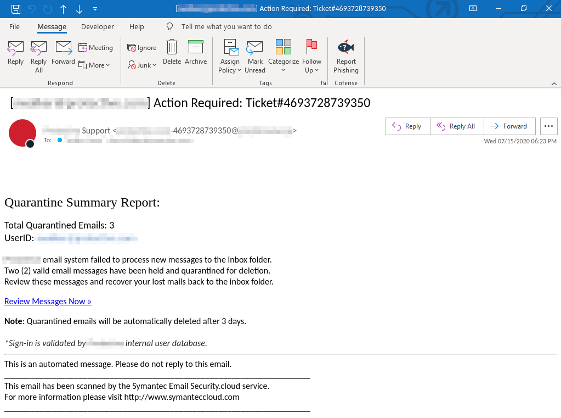
A screenshot of the phishing email. (Source: Cofense)

In the event that the recipient interacted with the link, the campaign sent them to a login screen that appeared to be hosted on the company’s website.

Cofense examined this technique in more detail and found out what was going on. It observed that the phishing link was designed to pull the homepage of the company included in the original recipient’s email address. As quoted from its research:

… [F]urther analysis has determined that the page being seen is actually the company’s website home page with a fake login panel covering it. This gives the employee a greater comfort level, by displaying to a familiar page. It is also possible to interact with this page by moving outside of the overlay, showing that it is the actual page they have seen and used before.

This overlay prompted the user to interact with the login form and to authenticate themselves using their company account. At that point, the campaign sent the victim’s credentials off to a server under the attackers’ control.

The phishing page with an overlay covering Cofense’s homepage. (Source: Cofense)

This attack highlights the need for organizations to defend themselves against phishing attacks. One of the ways they can do this is by educating their users about some of the most common phishing campaigns in circulation today. This resource serves as a good place to start.

The post ” Targeted Company’s Homepage Used in Message Quarantine Phish” appeared first on TripWire

Source:TripWire – David Bisson

Tags: Encryption, Phishing, TripWire

Continue Reading

Previous WhatsApp Discloses 6 Bugs via Dedicated Security Site
Next Attackers Steal Outlook Credentials Via Overlay Screens on Legitimate Sites

More Stories

  • Critical Vulnerability
  • Cyber Attacks
  • Vulnerabilities

Hackers Exploit Critical ASP.NET Anti-CSRF Library Flaw Allowing Unauthenticated RCE

4 hours ago [email protected] (The Hacker News)
  • Cyber Attacks
  • Malware
  • Vulnerabilities

Hackers Exploited GL.iNet Cloud Flaw to Install Malware on Routers and KVM Devices

5 hours ago [email protected] (The Hacker News)
  • Cyber Attacks

AI-Assisted Cyberattacks Trigger Unauthorized Payments at Indian Banks and Fintech Firms

5 hours ago [email protected] (The Hacker News)
  • Data Breach

OpenRouter Drops 3 Providers After Researchers Catch Months of Prompt Theft at AI Hosting Firms

1 day ago [email protected] (The Hacker News)
  • Cyber Attacks

A Single Malicious Webpage Let Researchers Hijack Meta Muse and Access Private Chats

2 days ago [email protected] (The Hacker News)
  • Critical Vulnerability
  • Data Breach
  • Vulnerabilities

GnuPG Warns Critical GPGME Flaw Could Expose App Data via Malicious OpenPGP Keys

2 days ago [email protected] (The Hacker News)

Recent Posts

  • Hackers Exploit Critical ASP.NET Anti-CSRF Library Flaw Allowing Unauthenticated RCE
  • Hackers Exploited GL.iNet Cloud Flaw to Install Malware on Routers and KVM Devices
  • AI-Assisted Cyberattacks Trigger Unauthorized Payments at Indian Banks and Fintech Firms
  • OpenRouter Drops 3 Providers After Researchers Catch Months of Prompt Theft at AI Hosting Firms
  • Researchers Demonstrate Ghostscript Sandbox-Escape RCE via Crafted File Uploads in Popular Apps

Tags

Android APT Bug CERT Cloud Compliance Coronavirus COVID-19 Critical Severity Encryption Exploit Facebook Finance Google Google Chrome Goverment Hacker Hacker News High Severity Instagram iPhone Java Linux Low Severity Malware Medium Severity Microsoft Moderate Severity Mozzila Firefox Oracle Patch Tuesday Phishing Privacy QuickHeal Ransomware RAT Sim The Hacker News Threatpost TikTok TripWire VMWARE Vulnerability Whatsapp Zoom
Copyright © 2020 All rights reserved | NGTEdu.com
This website uses cookies to improve your experience. We'll assume you're ok with this, but you can opt-out if you wish. Read More here.Cookie settingsACCEPT
Privacy & Cookies Policy

Privacy Overview

This website uses cookies to improve your experience while you navigate through the website. Out of these cookies, the cookies that are categorized as necessary are stored on your browser as they are essential for the working of basic functionalities of the website. We also use third-party cookies that help us analyze and understand how you use this website. These cookies will be stored in your browser only with your consent. You also have the option to opt-out of these cookies. But opting out of some of these cookies may have an effect on your browsing experience.
Necessary
Always Enabled
Necessary cookies are absolutely essential for the website to function properly. This category only includes cookies that ensures basic functionalities and security features of the website. These cookies do not store any personal information.
Non-necessary
Any cookies that may not be particularly necessary for the website to function and is used specifically to collect user personal data via analytics, ads, other embedded contents are termed as non-necessary cookies. It is mandatory to procure user consent prior to running these cookies on your website.
SAVE & ACCEPT