
Human Attacker Exploits Marimo RCE, Reaches SSH Bastion in Eight Seconds

With artificial intelligence (AI) shrinking the window between vulnerability discovery and exploitation and lowering the barrier to entry for bad actors, new findings from Sysdig show that skilled human operators can move just as swiftly after gaining initial access.
In one instance highlighted by the cloud security company, the threat actor pivoted from a vulnerable Marimo notebook to an SSH bastion host in eight seconds using a custom Python toolkit they “wrote and debugged by hand” without any AI agent in the loop.
“Eight seconds is the kind of speed we expect to see in AI-assisted attacks,” the Sysdig Threat Research Team said. “This operator got there on skill alone, and along the way walked straight past a trap that every agentic threat actor (ATA) we’ve profiled against this same CVE fell into. Not only can skilled human attackers move at machine speed, but they can also often better evade defenders’ detections.”
The attack chain has been found to exploit CVE-2026-39987 (CVSS score: 9.3), a pre-authenticated remote code execution vulnerability impacting all versions of Marimo that came under active exploitation within hours of public disclosure.
Upon gaining an initial foothold, the threat actor is said to have run an end-to-end credential-pivot chain, leveraging the Marimo flaw to gain a full interactive shell, followed by an Amazon Web Services (AWS) Secrets Manager call using credentials harvested from the compromised instance, and SSH access to a bastion host with the retrieved private key –
- 18:57:22: Fresh WebSocket connection
- 18:57:26: Lookup against the application’s stored credential returns the harvested AWS key
- 18:57:30: SSH authentication observed at the bastion host
The entire activity lasted from 12:52 p.m., when the first WebSocket connection was made from “172.236.12[.]17” to the “/terminal/ws WebSocket endpoint exposed by Marimo, to 9:50 p.m., during which the threat actor deployed an asyncssh-style listener setup against an attacker-owned VPS.
“Over the course of a nine-hour session, they issued more than 850 interactive commands, used no recognizable publicly available offensive tooling, and hand-rolled their scripts in-session,” Sysdig said. “The operator’s tradecraft converged on a single backgrounded Python3 invocation, not an agentic framework, that pulls the credential, fetches the SSH key from Secrets Manager, writes it to disk, and authenticates to the bastion over SSH in one shot.”
“AI may be changing the economics of attacks — more targets, faster time-to-exploit, and less manual grind on repetitive tasks — but it has not yet replaced the skilled attacker who knows how to build from scratch and avoid traps.”
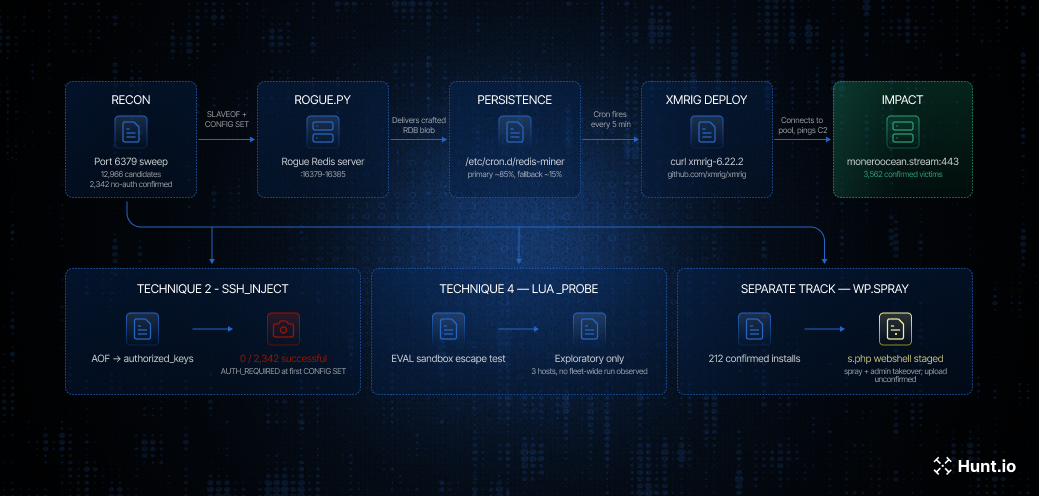
The findings come as Hunt.io disclosed details of a cryptomining campaign that has compromised 3,562 Redis servers likely following a broad internet sweep of candidate Redis hosts on port 6379, while simultaneously launching three parallel pipelines –
- WordPress target discovery, which scans a list of HTTPS hosts for WordPress version, installed plugins, and whether XML-RPC or directory listings are exposed
- AOF-based SSH authorized_keys injection, which uses Redis’s append-only file (AOF) mode to perform authorized_keys SSH key injection
- Lua sandbox-escape probing, which runs Redis EVAL commands and sandbox escape attempts against three hosts (“47.250.92[.]230,” “34.166.99[.]116,” and “20.198.10[.]42”)
The primary exploitation method is the use of the SLAVEOF command to smuggle attacker-controlled content onto a target Redis server, resulting in the deployment of an XMRig miner. The activity, which came to light after the discovery of an exposed working environment at 188.245.99[.]156, has not been attributed to any known threat actor or group.
“Confirmed victims span Redis 2.8.17 (2015) through 7.2.0 (2023) and Linux from EOL RHEL/CentOS 6 to current Ubuntu kernels, pointing to missing authentication as the weakness rather than a version-specific bug,” Hunt.io said.
“The toolkit runs four techniques across three services, but only Redis rogue replication worked at scale: SSH key-injection and MongoDB sandbox-escape returned zero across 2,810 attempts, and a complete WordPress credential-to-webshell chain was recovered but not confirmed at scale.”
In recent months, a single operator was also linked to a massive campaign dubbed Operation CameraSwarm that compromised over 14,000 Dahua IP cameras using brute-force attacks, authentication bypass flaws (CVE-2021-33044 and CVE-2021-33045), and a peer-to-peer (P2P) relay technique.
The post “Human Attacker Exploits Marimo RCE, Reaches SSH Bastion in Eight Seconds” appeared first on The Hacker News
Source:The Hacker News – [email protected] (The Hacker News)