
Skip to content
NGTEdu Logo

NGTEdu

A PRODUCT OF NGTECH.CO.IN

NGTEdu Logo

NGTEdu

  • Home
  • Cyber Attacks
  • Malware
  • Vulnerabilities
  • Data Breach
  • Home
  • Cyber Attacks
  • BlackRock Android Banking Malware Targeting 337 Mobile Apps
  • Cyber Attacks
  • Data Breach
  • Malware

BlackRock Android Banking Malware Targeting 337 Mobile Apps

6 years ago David Bisson
BlackRock Android Banking Malware Targeting 337 Mobile Apps

Security researchers discovered a new Android banking malware family called “BlackRock” that targets 337 mobile applications.

ThreatFabric found that BlackRock hid its icon when it first launched itself on a mobile device. It then posed as a Google update in an attempt to gain access to a user’s Accessibility Service. Once it received access to these privileges, the malware granted itself additional permissions that enabled it to communicate with its command-and-control (C&C) server and to perform overlay attacks.

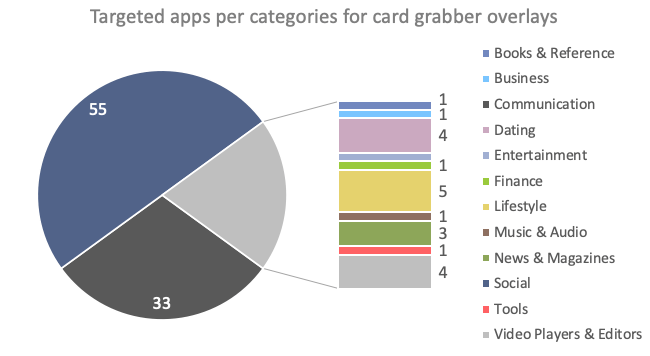
At this stage in its infection chain, BlackRock checked to see which app was running in the foreground on the infected device. The Android malware then had the option of deploying one of two types of overlays: a generic credit card grabber or an overlay that specifically mimicked one of 337 applications that appeared on the threat’s target lists.

In analyzing BlackRock’s target list, ThreatFabric found that the majority of apps related to banking operations in Europe followed by Australia, the United States and then Canada. Even so, the security firm found that the banking malware also went after social, communication, lifestyle and even dating programs.

As it explained in its research:

Most of the trending social and dating apps are included, the actors’ choice might have been driven by the pandemic situation, pushing people to socialized more online. It also seems that actors have made a particular effort on including dating apps, which wasn’t something common in targets list so far.
Source: ThreatFabric

According to ThreatFabric’s analysis, BlackRock arrived as the latest attempt by malicious actors to revive LokiBot. This threat first appeared on the threat landscape in 2016 and 2017 with various attack campaigns, including one in which it deployed ransomware if a user attempted to remove it. LokiBot died down after its source code appeared online, though it was involved in some attack operations as recently as May 2019.

The emergence of BlackRock highlights the need for organizations to defend themselves against mobile banking malware by downloading apps only from trusted developers on official app marketplaces, keeping an eye out for apps that require excessive permissions and protecting their banking accounts with some form of multi-factor authentication.

The post ” BlackRock Android Banking Malware Targeting 337 Mobile Apps” appeared first on TripWire

Source:TripWire – David Bisson

Tags: Android, Encryption, Google, Malware, Ransomware, TripWire

Continue Reading

Previous Amazon-Themed Phishing Campaigns Swim Past Security Checks
Next Zoom Addresses Vanity URL Zero-Day

More Stories

  • Critical Vulnerability
  • Cyber Attacks
  • Vulnerabilities

Hackers Exploit Critical ASP.NET Anti-CSRF Library Flaw Allowing Unauthenticated RCE

5 hours ago [email protected] (The Hacker News)
  • Cyber Attacks
  • Malware
  • Vulnerabilities

Hackers Exploited GL.iNet Cloud Flaw to Install Malware on Routers and KVM Devices

5 hours ago [email protected] (The Hacker News)
  • Cyber Attacks

AI-Assisted Cyberattacks Trigger Unauthorized Payments at Indian Banks and Fintech Firms

6 hours ago [email protected] (The Hacker News)
  • Data Breach

OpenRouter Drops 3 Providers After Researchers Catch Months of Prompt Theft at AI Hosting Firms

1 day ago [email protected] (The Hacker News)
  • Cyber Attacks

A Single Malicious Webpage Let Researchers Hijack Meta Muse and Access Private Chats

2 days ago [email protected] (The Hacker News)
  • Critical Vulnerability
  • Data Breach
  • Vulnerabilities

GnuPG Warns Critical GPGME Flaw Could Expose App Data via Malicious OpenPGP Keys

2 days ago [email protected] (The Hacker News)

Recent Posts

  • Hackers Exploit Critical ScreenConnect Flaw to Hijack MSP Technician PCs Without Warning
  • Hackers Exploit Critical ASP.NET Anti-CSRF Library Flaw Allowing Unauthenticated RCE
  • Hackers Exploited GL.iNet Cloud Flaw to Install Malware on Routers and KVM Devices
  • AI-Assisted Cyberattacks Trigger Unauthorized Payments at Indian Banks and Fintech Firms
  • OpenRouter Drops 3 Providers After Researchers Catch Months of Prompt Theft at AI Hosting Firms

Tags

Android APT Bug CERT Cloud Compliance Coronavirus COVID-19 Critical Severity Encryption Exploit Facebook Finance Google Google Chrome Goverment Hacker Hacker News High Severity Instagram iPhone Java Linux Low Severity Malware Medium Severity Microsoft Moderate Severity Mozzila Firefox Oracle Patch Tuesday Phishing Privacy QuickHeal Ransomware RAT Sim The Hacker News Threatpost TikTok TripWire VMWARE Vulnerability Whatsapp Zoom
Copyright © 2020 All rights reserved | NGTEdu.com
This website uses cookies to improve your experience. We'll assume you're ok with this, but you can opt-out if you wish. Read More here.Cookie settingsACCEPT
Privacy & Cookies Policy

Privacy Overview

This website uses cookies to improve your experience while you navigate through the website. Out of these cookies, the cookies that are categorized as necessary are stored on your browser as they are essential for the working of basic functionalities of the website. We also use third-party cookies that help us analyze and understand how you use this website. These cookies will be stored in your browser only with your consent. You also have the option to opt-out of these cookies. But opting out of some of these cookies may have an effect on your browsing experience.
Necessary
Always Enabled
Necessary cookies are absolutely essential for the website to function properly. This category only includes cookies that ensures basic functionalities and security features of the website. These cookies do not store any personal information.
Non-necessary
Any cookies that may not be particularly necessary for the website to function and is used specifically to collect user personal data via analytics, ads, other embedded contents are termed as non-necessary cookies. It is mandatory to procure user consent prior to running these cookies on your website.
SAVE & ACCEPT