
Skip to content
NGTEdu Logo

NGTEdu

A PRODUCT OF NGTECH.CO.IN

NGTEdu Logo

NGTEdu

  • Home
  • Cyber Attacks
  • Malware
  • Vulnerabilities
  • Data Breach
  • Home
  • Data Breach
  • Sextortionists Using Social Engineering Tactics to Collect Victims’ Data
  • Data Breach

Sextortionists Using Social Engineering Tactics to Collect Victims’ Data

6 years ago David Bisson
Sextortionists Using Social Engineering Tactics to Collect Victims’ Data

Security researchers observed sextortionists leveraging social engineering techniques to steal their victims’ personal information.

SANS’ Internet Storm Center (ISC) discovered that sextortionists had begun creating profiles for young women on dating websites. They used those profiles and the stated interest of finding “good times” to connect with new contacts on the platforms.

Once they connected with someone on the dating website, they used social engineering techniques to convince their target into disclosing their names, mobile phone numbers, locations, sexual preferences and other information. The sextortionists then posted that data on a publicly available Ukrainian forum.

At the time of discovery, the forum contained a page informing victims that they could become “unlisted” from the website by paying a fee to “help the project.” But the Internet Storm Center found that victims’ information would likely remain on the website regardless. As quoted in a post published by the program:

The forum seems to be online for a while but is still filled with new data. The problem is that, even if the victim pays, the forum is indexed by Google and other search engines (like the very popular yandex.ru). This makes the process to be unlisted very difficult, if not impossible!
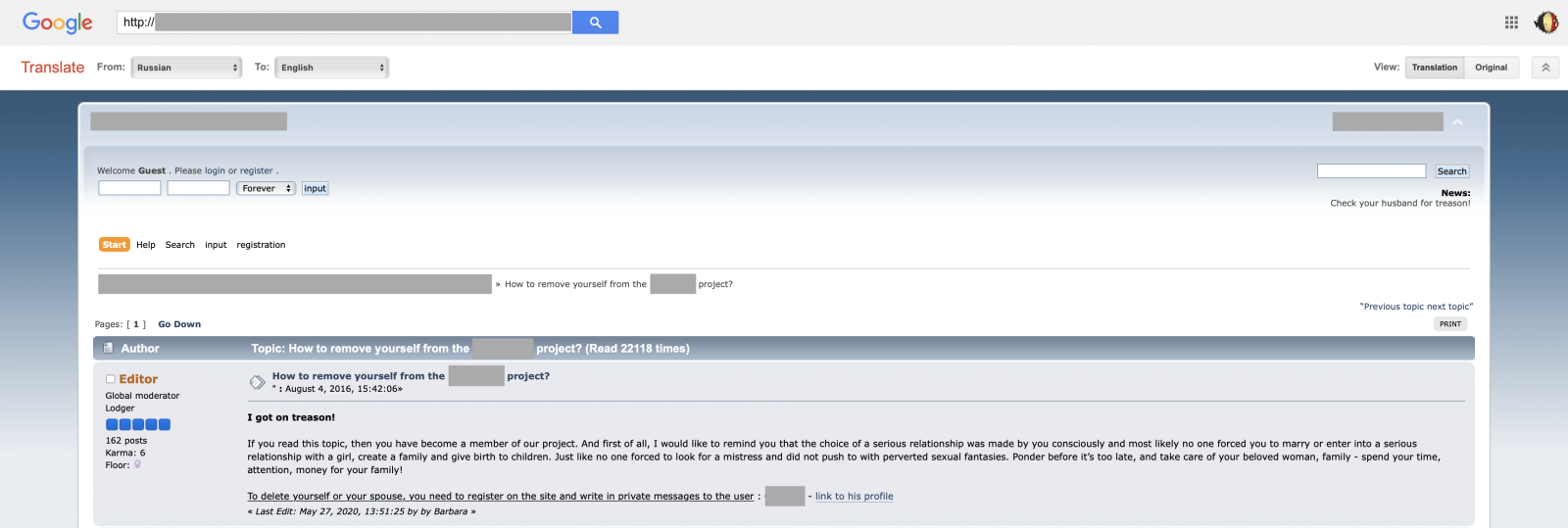
A screenshot of a forum providing victims with steps on how they can become unlisted. (Source: SANS Internet Storm Center)

This isn’t the first time that sextortionists have abused victims’ personal information. Back in July 2018, for instance, researchers detected a sextortion scam attempt that used breached passwords to trick their victims into thinking that they had suffered a data breach. It was a month later when another variant emerged in which scammers incorporated redacted victims’ phone numbers into their ploys.

The sextortion campaign described above underscores the importance of users not divulging their personal information with contacts on dating websites. Here are some additional tips on how they can keep themselves and their data safe.

The post ” Sextortionists Using Social Engineering Tactics to Collect Victims’ Data” appeared first on TripWire

Source:TripWire – David Bisson

Tags: Encryption, Google, TripWire

Continue Reading

Previous Oracle E-Business Suite Flaws Let Hackers Hijack Business Operations
Next New Ripple20 Flaws Put Billions of Internet-Connected Devices at Risk of Hacking

More Stories

  • Critical Vulnerability
  • Data Breach

When Cloud Outages Ripple Across the Internet

3 hours ago [email protected] (The Hacker News)
  • Cyber Attacks
  • Data Breach
  • Malware
  • Vulnerabilities

APT28 Uses Microsoft Office CVE-2026-21509 in Espionage-Focused Malware Attacks

4 hours ago [email protected] (The Hacker News)
  • Cyber Attacks
  • Data Breach

Mozilla Adds One-Click Option to Disable Generative AI Features in Firefox

8 hours ago [email protected] (The Hacker News)
  • Cyber Attacks
  • Data Breach
  • Malware
  • Vulnerabilities

Notepad++ Hosting Breach Attributed to China-Linked Lotus Blossom Hacking Group

9 hours ago [email protected] (The Hacker News)
  • Cyber Attacks
  • Data Breach
  • Malware
  • Vulnerabilities

Researchers Find 341 Malicious ClawHub Skills Stealing Data from OpenClaw Users

20 hours ago [email protected] (The Hacker News)
  • Cyber Attacks
  • Data Breach
  • Vulnerabilities

OpenClaw Bug Enables One-Click Remote Code Execution via Malicious Link

21 hours ago [email protected] (The Hacker News)

Recent Posts

  • When Cloud Outages Ripple Across the Internet
  • APT28 Uses Microsoft Office CVE-2026-21509 in Espionage-Focused Malware Attacks
  • Mozilla Adds One-Click Option to Disable Generative AI Features in Firefox
  • Notepad++ Hosting Breach Attributed to China-Linked Lotus Blossom Hacking Group
  • Researchers Find 341 Malicious ClawHub Skills Stealing Data from OpenClaw Users

Tags

Android APT Bug CERT Cloud Compliance Coronavirus COVID-19 Critical Severity Encryption Exploit Facebook Finance Google Google Chrome Goverment Hacker Hacker News High Severity Instagram iPhone Java Linux Low Severity Malware Medium Severity Microsoft Moderate Severity Mozzila Firefox Oracle Patch Tuesday Phishing Privacy QuickHeal Ransomware RAT Sim The Hacker News Threatpost TikTok TripWire VMWARE Vulnerability Whatsapp Zoom
Copyright © 2020 All rights reserved | NGTEdu.com
This website uses cookies to improve your experience. We'll assume you're ok with this, but you can opt-out if you wish. Read More here.Cookie settingsACCEPT
Privacy & Cookies Policy

Privacy Overview

This website uses cookies to improve your experience while you navigate through the website. Out of these cookies, the cookies that are categorized as necessary are stored on your browser as they are essential for the working of basic functionalities of the website. We also use third-party cookies that help us analyze and understand how you use this website. These cookies will be stored in your browser only with your consent. You also have the option to opt-out of these cookies. But opting out of some of these cookies may have an effect on your browsing experience.
Necessary
Always Enabled
Necessary cookies are absolutely essential for the website to function properly. This category only includes cookies that ensures basic functionalities and security features of the website. These cookies do not store any personal information.
Non-necessary
Any cookies that may not be particularly necessary for the website to function and is used specifically to collect user personal data via analytics, ads, other embedded contents are termed as non-necessary cookies. It is mandatory to procure user consent prior to running these cookies on your website.
SAVE & ACCEPT