
Skip to content
NGTEdu Logo

NGTEdu

A PRODUCT OF NGTECH.CO.IN

NGTEdu Logo

NGTEdu

  • Home
  • Cyber Attacks
  • Malware
  • Vulnerabilities
  • Data Breach
  • Home
  • Cyber Attacks
  • $43 billion stolen through Business Email Compromise since 2016, reports FBI
  • Cyber Attacks
  • Data Breach

$43 billion stolen through Business Email Compromise since 2016, reports FBI

4 years ago Graham Cluley
$43 billion stolen through Business Email Compromise since 2016, reports FBI

Over US $43 billion has been lost through Business Email Compromise attacks since 2016, according to data released this week by the FBI.

The FBI’s Internet Crime Complaint Center (IC3) issued a public service announcement on May 4 2022, sharing updated statistics on Business Email Compromise (BEC) attacks which use a variety of social engineering and phishing techniques to break into accounts and trick companies into transferring large amounts of money into the hands of criminals.

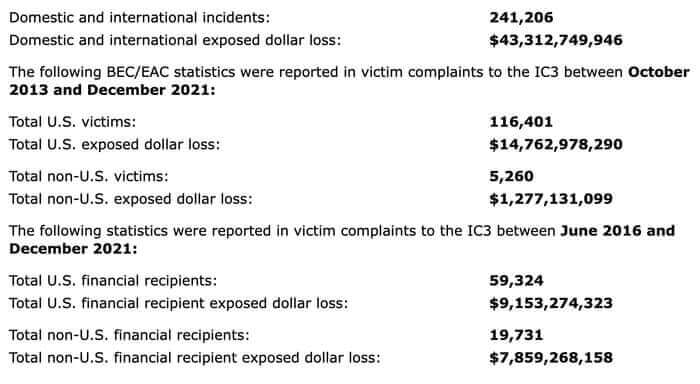
The report looked at 241,206 incidents reported to law enforcement and banking institutions between June 2016 and December 2021, and says that the combined domestic and international losses incurred amounted to US $43.31 billion.

Worryingly, there has been a 65% increase recorded in identified global losses between July 2019 and December 2021. The report suggests that this increase can be “partly attributed to the restrictions placed on normal business practices during the COVID-19 pandemic” with many workers forced to do their jobs remotely.
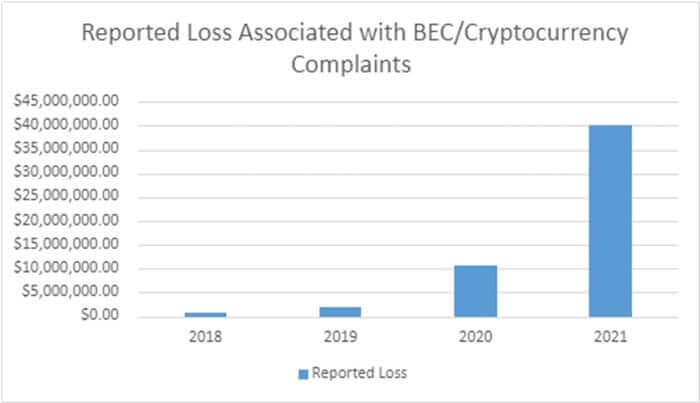
The rise of interest in cryptocurrency has also been seen in the stats, with an increased number of complaints recorded involving digital funds. For instance, the report notes how scammers have used direct transfer of funds to cryptocurrency exchanges (or a “second hop” transfer to a cryptocurrency exchange) in a seeming attempt to anonymise the movement and ownership of stolen funds.
The FBI offers a number of tips to companies wishing to better protect themselves from Business Email Compromise attacks:

  • Use secondary channels or two-factor authentication to verify requests for changes in account information.
  • Ensure the URL in emails is associated with the business/individual it claims to be from.
  • Be alert to hyperlinks that may contain misspellings of the actual domain name.
  • Refrain from supplying login credentials or PII of any sort via email. Be aware that many emails requesting your personal information may appear to be legitimate.
  • Verify the email address used to send emails, especially when using a mobile or handheld device, by ensuring the sender’s address appears to match who it is coming from.
  • Ensure the settings in employees’ computers are enabled to allow full email extensions to be viewed.
  • Monitor your personal financial accounts on a regular basis for irregularities, such as missing deposits.

Organisations are also advised to immediately contact their financial institution should they believe that they have fallen victim to fraudsters, as it may be possible to request a recall of funds. Regardless of the amount stolen, victims of Business Email Compromise are urged to file their complaint at bec.ic3.gov as soon as possible.


Editor’s Note: The opinions expressed in this guest author article are solely those of the contributor, and do not necessarily reflect those of Tripwire, Inc.

The post ” $43 billion stolen through Business Email Compromise since 2016, reports FBI” appeared first on TripWire

Source:TripWire – Graham Cluley

Tags: COVID-19, Encryption, Finance, Goverment, Phishing, TripWire

Continue Reading

Previous CANs Reinvent LANs for an All-Local World
Next NIST Releases Updated Cybersecurity Guidance for Managing Supply Chain Risks

More Stories

  • Data Breach
  • Vulnerabilities

OpenAI Patches ChatGPT Data Exfiltration Flaw and Codex GitHub Token Vulnerability

2 hours ago [email protected] (The Hacker News)
  • Data Breach
  • Malware

DeepLoad Malware Uses ClickFix and WMI Persistence to Steal Browser Credentials

4 hours ago [email protected] (The Hacker News)
  • Cyber Attacks

⚡ Weekly Recap: Telecom Sleeper Cells, LLM Jailbreaks, Apple Forces U.K. Age Checks and More

6 hours ago [email protected] (The Hacker News)
  • Cyber Attacks
  • Data Breach

Iran-Linked Hackers Breach FBI Director’s Personal Email, Hit Stryker With Wiper Attack

2 days ago [email protected] (The Hacker News)
  • Critical Vulnerability
  • Cyber Attacks
  • Vulnerabilities

CISA Adds CVE-2025-53521 to KEV After Active F5 BIG-IP APM Exploitation

3 days ago [email protected] (The Hacker News)
  • Critical Vulnerability
  • Cyber Attacks

Apple Sends Lock Screen Alerts to Outdated iPhones Over Active Web-Based Exploits

3 days ago [email protected] (The Hacker News)

Recent Posts

  • OpenAI Patches ChatGPT Data Exfiltration Flaw and Codex GitHub Token Vulnerability
  • DeepLoad Malware Uses ClickFix and WMI Persistence to Steal Browser Credentials
  • ⚡ Weekly Recap: Telecom Sleeper Cells, LLM Jailbreaks, Apple Forces U.K. Age Checks and More
  • 3 SOC Process Fixes That Unlock Tier 1 Productivity
  • The State of Secrets Sprawl 2026: 9 Takeaways for CISOs

Tags

Android APT Bug CERT Cloud Compliance Coronavirus COVID-19 Critical Severity Encryption Exploit Facebook Finance Google Google Chrome Goverment Hacker Hacker News High Severity Instagram iPhone Java Linux Low Severity Malware Medium Severity Microsoft Moderate Severity Mozzila Firefox Oracle Patch Tuesday Phishing Privacy QuickHeal Ransomware RAT Sim The Hacker News Threatpost TikTok TripWire VMWARE Vulnerability Whatsapp Zoom
Copyright © 2020 All rights reserved | NGTEdu.com
This website uses cookies to improve your experience. We'll assume you're ok with this, but you can opt-out if you wish. Read More here.Cookie settingsACCEPT
Privacy & Cookies Policy

Privacy Overview

This website uses cookies to improve your experience while you navigate through the website. Out of these cookies, the cookies that are categorized as necessary are stored on your browser as they are essential for the working of basic functionalities of the website. We also use third-party cookies that help us analyze and understand how you use this website. These cookies will be stored in your browser only with your consent. You also have the option to opt-out of these cookies. But opting out of some of these cookies may have an effect on your browsing experience.
Necessary
Always Enabled
Necessary cookies are absolutely essential for the website to function properly. This category only includes cookies that ensures basic functionalities and security features of the website. These cookies do not store any personal information.
Non-necessary
Any cookies that may not be particularly necessary for the website to function and is used specifically to collect user personal data via analytics, ads, other embedded contents are termed as non-necessary cookies. It is mandatory to procure user consent prior to running these cookies on your website.
SAVE & ACCEPT